Most people never find out that Ushuaia has a winter. From late June the valleys behind the town fill with snow, and the day that follows is the reason to come and see it: snowshoes in the morning, a heated dome for lunch, and an afternoon of huskies, snowmobiles and a tracked vehicle crossing the white plain.
Eight hours in the Tierra Mayor valley, from your hotel door and back again.
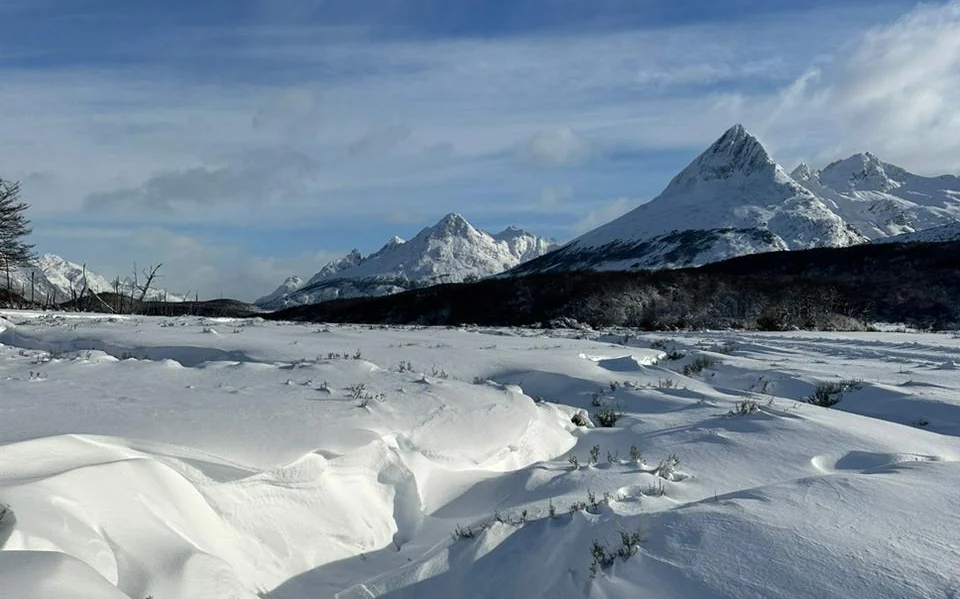
The day begins with a pick-up at your hotel and a drive of about twenty kilometres inland, out of town and up into the Tierra Mayor valley — a broad, flat, white corridor between the mountains that in summer is peat bog and in winter is one of the best cross-country snow areas in South America.
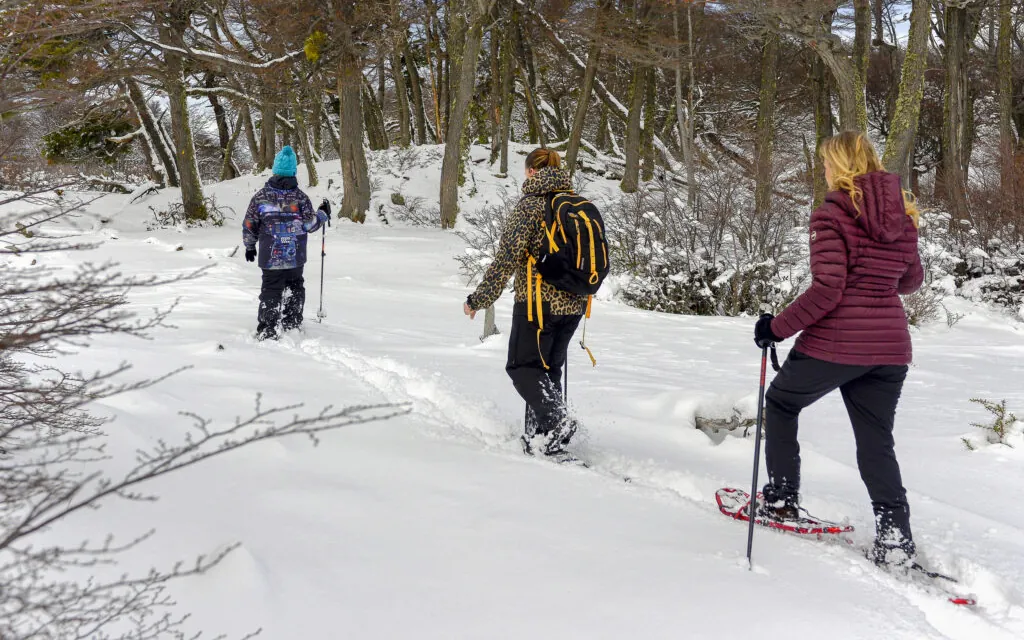
You are fitted with snowshoes and you walk. Through the lénga forest first, then out into the open valley, stopping at viewpoints over the Fuegian range. It is easier than it sounds — snowshoes spread your weight so you stay on top of the snow instead of sinking into it, and the ground here is level. No experience is needed and nobody is racing.
The walk lasts around an hour and a half. It ends with the part that turns every group back into children: plastic toboggans and a slope.
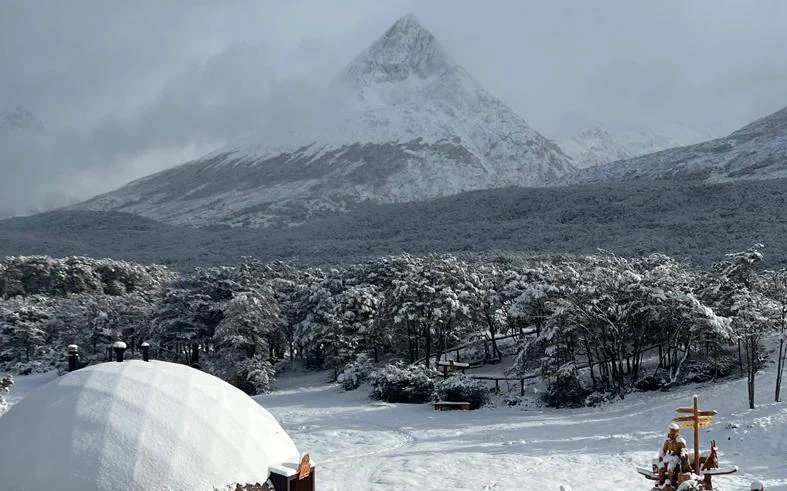
This is where a winter day either works or falls apart, and it is worth being specific about it. You do not eat a sandwich standing in the wind. Lunch is inside a heated geodesic dome set in the forest, at a table, with your coat off.
The menu is Patagonian and it is included: empanadas to start, a mountain stew of meat, vegetables and wild mushrooms as the main course, and apples poached in wine to finish. There is time to sit still, dry out and warm your hands before the afternoon begins.
If anyone in your group is vegetarian, coeliac or has any other dietary requirement, tell us when you enquire and we arrange it in advance rather than on the day.
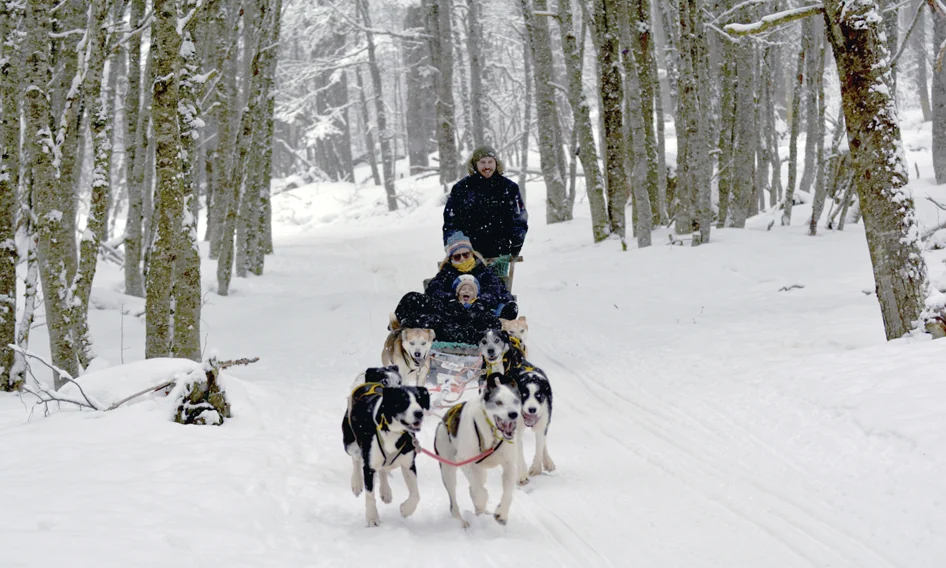
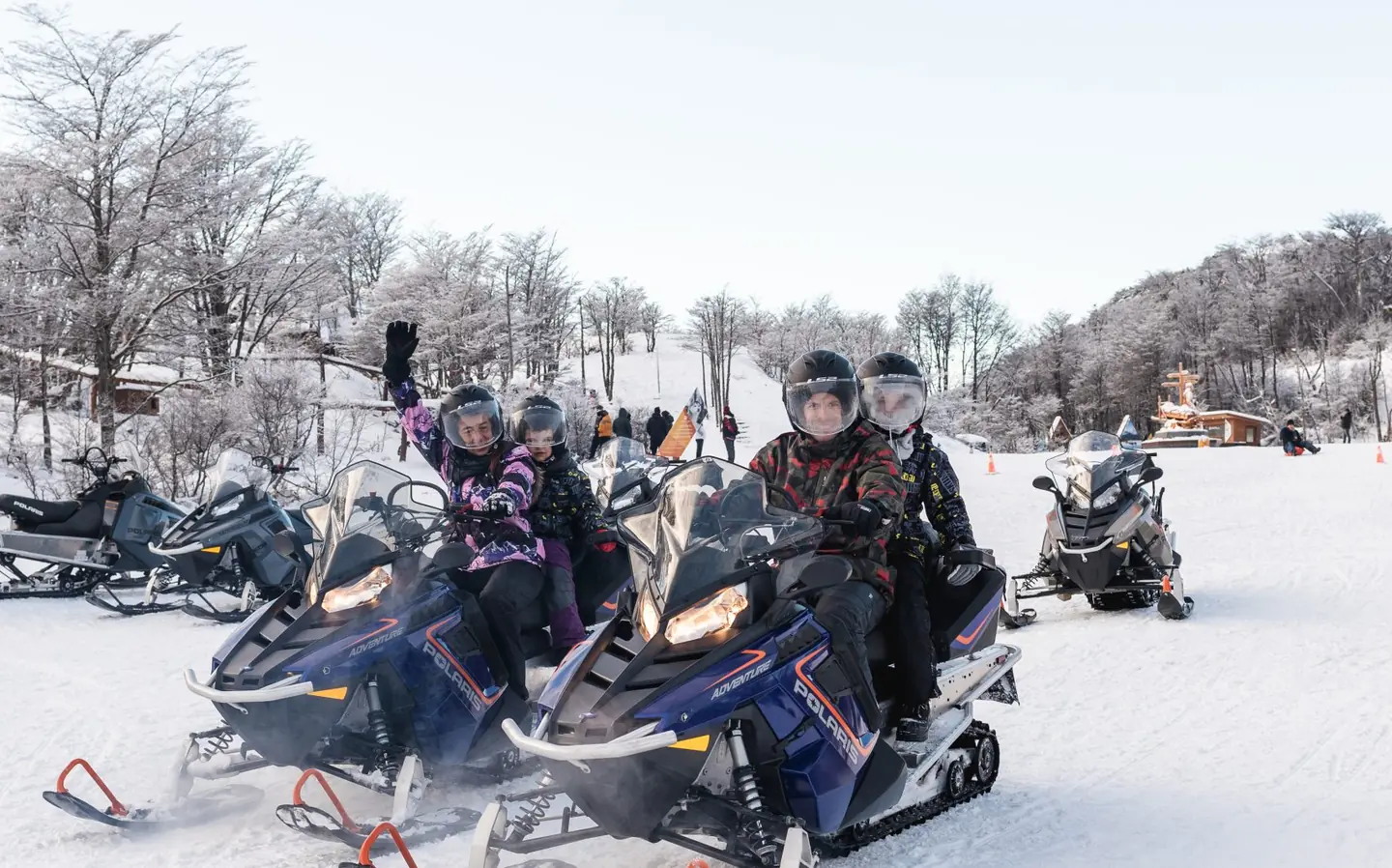
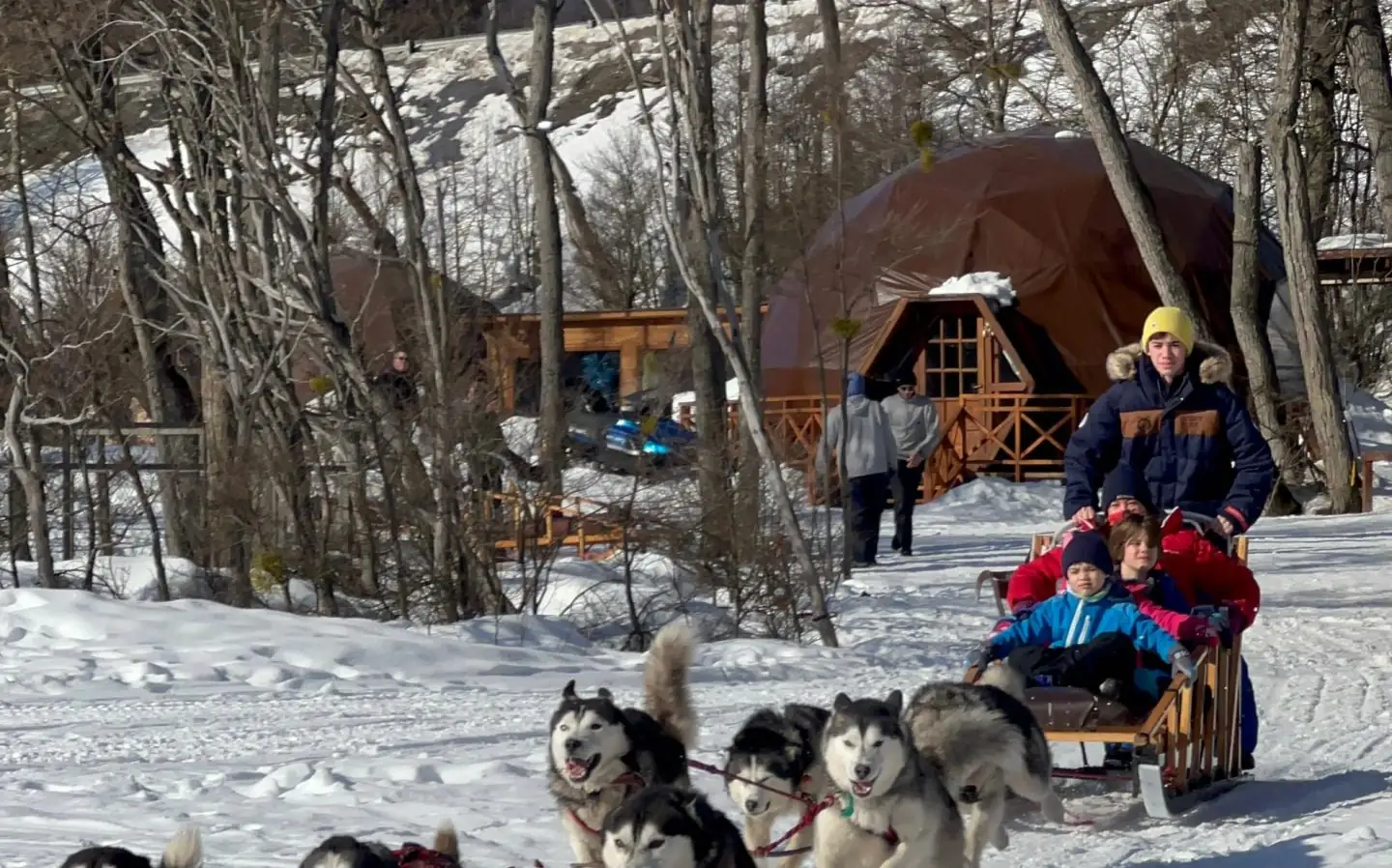
After lunch the group splits and rotates through three things, so nobody waits around. You drive a snowmobile on a marked circuit with a guide leading; you cross the open valley in a tracked snow vehicle, the kind that goes where nothing on wheels can, stopping in the middle of the plain for photographs; and you ride a sled pulled by a team of huskies.
The dogs are the part people talk about afterwards. These are working Siberian and Alaskan huskies, bred and trained for it, and the run is short but genuinely fast — the only sound is the sled on the snow. The day ends back at the kennels with time to meet the dogs and the puppies properly, which for most families turns out to be the photograph they keep.
The order of the three can change on the day depending on snow conditions and the size of the group. That call belongs to the guide on site, and it is the right way round.
Times are the usual pattern. The order can change with the snow and the size of the group.
Around 08:30
Collection from your hotel or apartment in Ushuaia. The drive inland to the valley is roughly twenty kilometres and takes about forty minutes, climbing away from the Beagle Channel into the mountains.
Around 09:30
A welcome at the winter centre, the plan for the day, and the equipment you need. Snowshoes are fitted here.
About 1 hour 30
Through the lénga forest and out into the open valley, with stops at panoramic points over the Fuegian range. Level ground, no experience required, guided throughout.
Before lunch
Plastic sleds on the slope beside the base. There is no dignified way to describe this and no group has ever declined it.
Around 12:30
Empanadas, a mountain stew with meat, vegetables and wild mushrooms, and apples in wine. Indoors, at a table, with time to warm up. Dietary requirements arranged in advance.
From about 13:30
The three afternoon activities, done in rotation by group. A guided snowmobile circuit, a crossing of the snow plain in the tracked vehicle with a photo stop, and the husky sled ride.
Around 16:00
Back at the kennels to meet the huskies and the puppies, with time for photographs before heading back.
Around 16:30
The transfer back to your accommodation in town, arriving in the late afternoon.
The season runs from 21 June to 30 September, and only when there is enough snow. If you are in Ushuaia in January this tour does not exist — and if you are there in July, it is the single best day available to you.
Most winter excursions sell you one thing. This is the snowshoe hike, the husky sled, the snowmobile and the tracked vehicle in the same day, with lunch in the middle. It is the reason it is called a full day.
You ride behind a working team, and afterwards you get time at the kennels with the dogs and the puppies. For families travelling with children this is usually the memory of the whole trip to Argentina.
Transfers from your door, a heated dome for lunch, and a base to come back to between activities. A winter day in Patagonia is only enjoyable if it is organised properly, and this one is.
The end of the world is busy from November to March and quiet the rest of the year. In winter the valleys are empty, the light is extraordinary and the town belongs to the people who live there.
Legajo EVT 17869, ASTA member 900202085, an office in Buenos Aires and over twenty years arranging trips across Argentina. One person answers you, start to finish.
No — this is a winter-only tour. It operates from 21 June to 30 September, and only when there is enough snow in the valley. In the southern hemisphere those are the winter months.
If you are travelling to Ushuaia between November and March, the valley is green and this day does not exist. What you would do instead is the Beagle Channel, the national park and the mountains — tell us your dates and we will send you what actually runs while you are there, rather than sell you something that does not.
No, and they are not alternatives to each other. Cerro Castor is a downhill ski resort with lifts and pistes, and it is a separate thing entirely.
This day takes place in the Tierra Mayor valley, which is flat, and involves no skiing at all. You need no equipment, no lessons and no previous experience. Plenty of people do both on the same trip; if you want to ski as well, ask us and we will quote it separately.
None. The snowmobile runs on a marked circuit with a guide leading the group and a briefing before you start. The husky sled is driven by a musher — you are a passenger.
The snowshoe hike is the same story: snowshoes take about a minute to learn and the valley is level.
Yes, and it is one of the best family days in Argentine Patagonia. The toboggans, the dogs and the tracked vehicle are all things children remember, and the heated dome means nobody has to be brave about the cold.
Minimum ages apply to driving a snowmobile, and younger children ride as passengers. Tell us the ages in your group when you enquire and we will confirm exactly what each person can do.
It is not recommended if you are pregnant, or if you have back, spine or knee problems, or any condition that means you should avoid vibration and uneven ground. The tracked vehicle and the snowmobile are both bumpy by nature.
If you are unsure whether something in your group rules it out, tell us before you book rather than on the morning — there are gentler winter options and we would rather put you on the right one.
Warm clothing is not included, so bring it. A waterproof and windproof jacket and trousers, thermal layers underneath, waterproof boots with grip, gloves, a hat that covers your ears, sunglasses and sunscreen. Snow glare at this latitude is strong even on an overcast day.
Clothing and boots can be hired in Ushuaia if you are not carrying them. Ask us when you book and we will point you to where.
The season opens on 21 June but it is always subject to snow conditions, and early or late in the season the full programme is not always possible.
If conditions on your date mean part of the day cannot run, you are told before you set out and we sort out the alternative or the refund with you. We will not send you up the valley hoping for the best.
It is a fair question and the honest answer is that it depends on what you came for. You lose the Beagle Channel penguin colonies and the long walks in the national park, both of which are summer things.
What you gain is a version of the end of the world that almost no foreign visitor sees: snow to the waterline, about seven hours of low golden daylight, empty valleys, and a town that is not full of cruise passengers. If you are coming for the landscape and the atmosphere rather than the wildlife, winter is arguably the better trip.
Ask most travellers when you go to Patagonia and they will say summer, because that is what everyone says. It is not wrong — from November to March you get the penguins, the long days and the walking. But it means that a whole season of the end of the world goes almost entirely unseen by anyone who does not live there.
From late June the valleys behind Ushuaia are under snow, and this is the day that uses them properly. It is not one activity stretched out to fill eight hours; it is four genuinely different things with a hot lunch in the middle, in a valley that on a weekday in July you will more or less have to yourselves.
The catch is the calendar, and we would rather be blunt about it than have you find out late: 21 June to 30 September, snow permitting. Send us your dates. If they fall in the window we will tell you what a winter week in Ushuaia looks like around this day, and if they do not, we will tell you that too.
Free quotation within 24 hours, with no obligation. Tell us your dates and how many of you are travelling, and we will confirm whether the season is open on those days, what the snow is doing, and how the day fits with the rest of your time in Argentina.
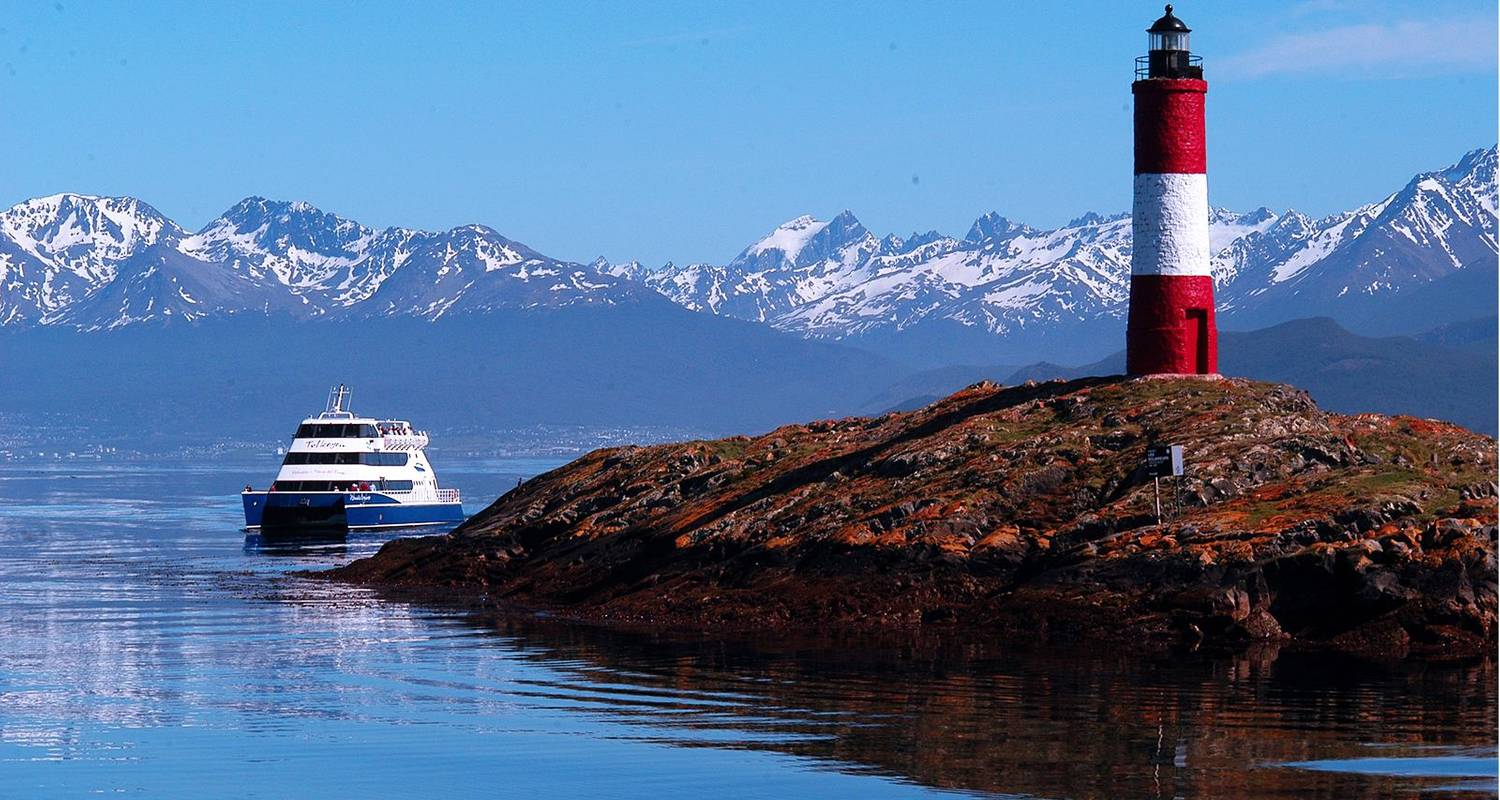
Everything we run at the end of the world, from half-day outings to full packages with flights.
See all Ushuaia tours →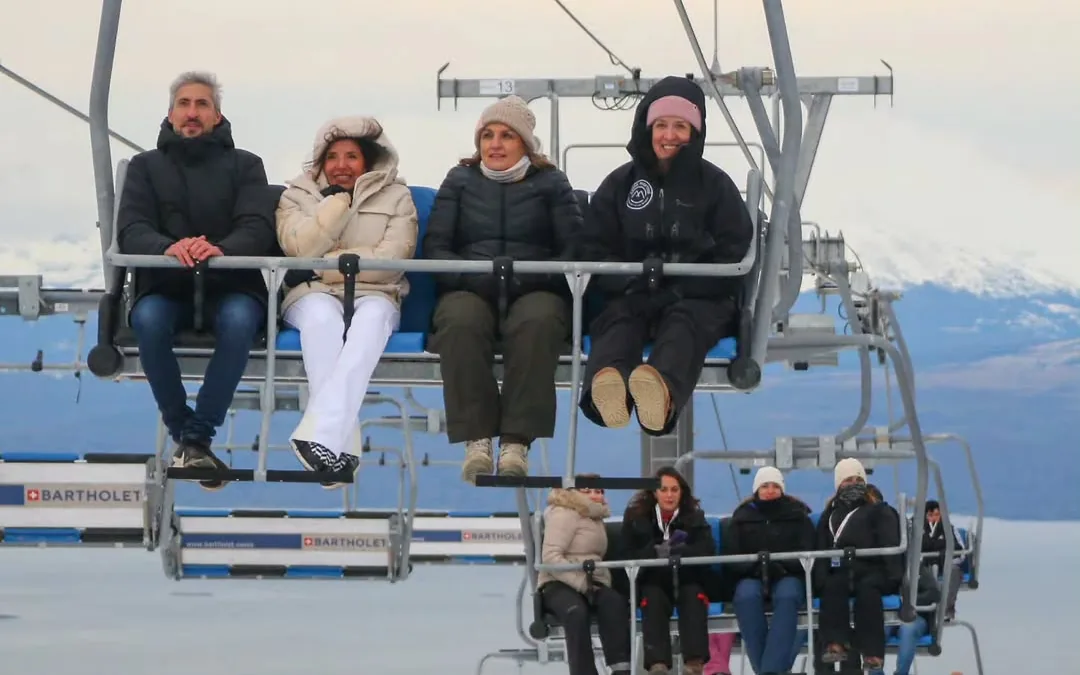
A half day that ends with the new chairlift and the best view over the town and the Beagle Channel.
More information →
Iguazú, Buenos Aires, Ushuaia and the glaciers of El Calafate in a single trip.
More information →