Two countries, two national parks, 275 waterfalls and an international border in the middle. Most of what goes wrong at Iguazú goes wrong in the planning, not on the day. Here are the answers, with the numbers, from an agency that has been sending travellers here for over twenty years.
The single most common mistake at Iguazú is booking one night. The falls are split across two national parks in two different countries, and each one is a full day. Here is what each length of stay really gets you.
You land, you walk the Argentine park, you fly out. You will see the Devil's Throat, the Upper and Lower Circuits and roughly 80% of the waterfalls. What you will not see is the panorama — the wide view of the whole cataract that appears on every postcard is taken from Brazil. Workable when your dates are fixed. Nobody who does it wishes they had stayed less.
One full day in Argentina, one in Brazil. Argentina puts you on top of the water; Brazil stands you back far enough to see all of it at once. They are genuinely different experiences, and two days is the length at which people stop rushing and start enjoying it. This is what most of our travellers book.
The two parks, and a third day for the boat ride under the falls, the Macuco trail, the bird park or the Jesuit ruins of San Ignacio. Worth it if you like being outdoors and would rather not spend both days walking to a schedule.
Two different national parks in two different countries, and they are not interchangeable. This is what each one gives you.
The Argentine park holds about 80% of the 275 waterfalls, and its walkways take you out over them. The Devil's Throat is reached by a 1.1 km catwalk across the upper river, and you stand at the lip of a horseshoe where a large part of the river disappears under your feet. The Upper Circuit runs along the tops of the falls; the Lower Circuit descends through rainforest to look up at them from below.
It is a walking day — four to six hours with the circuits and the train. It is also the side where the wildlife is: coatis, toucans, capuchin monkeys and great dusky swifts nesting behind the falling water.
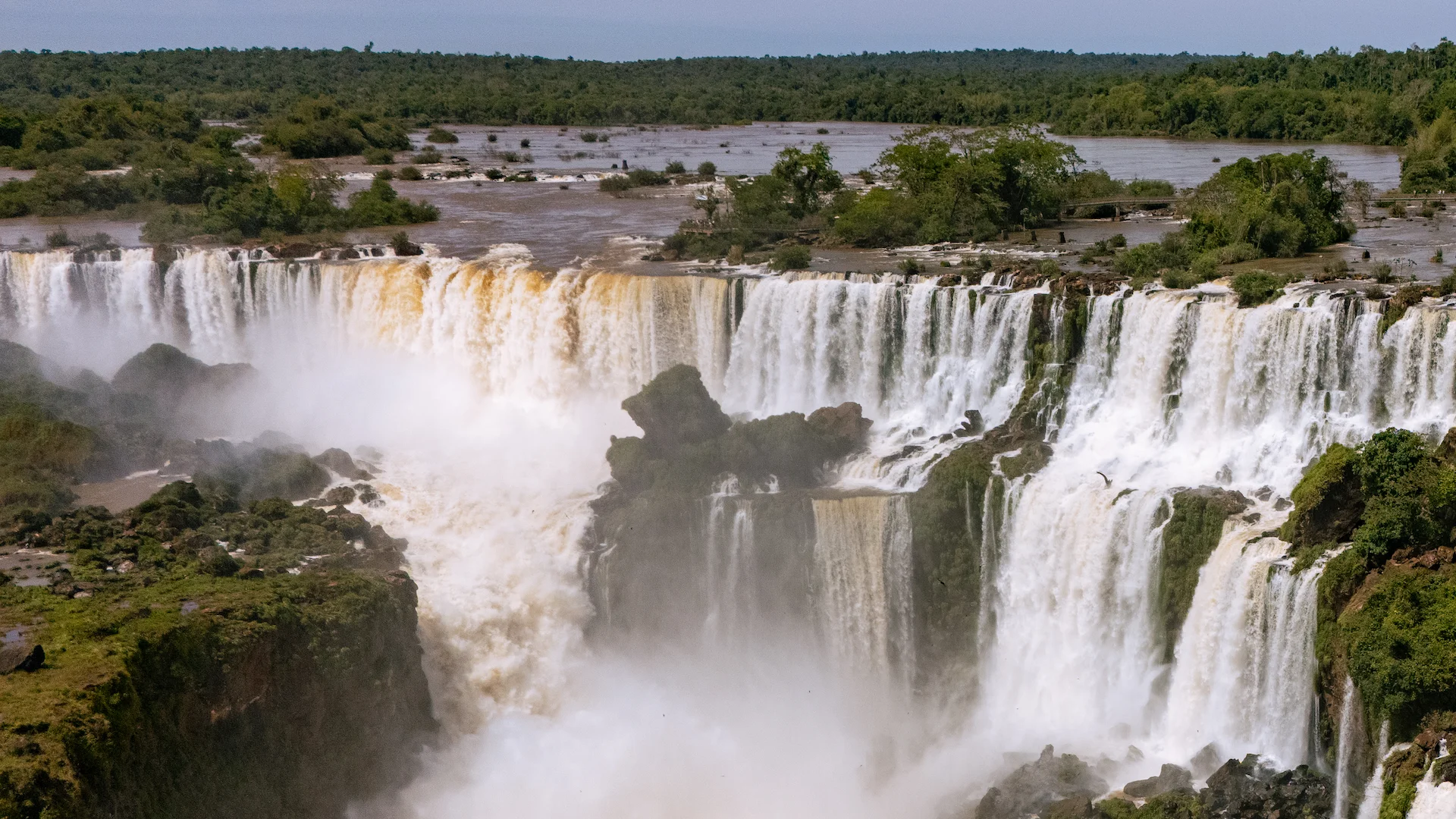
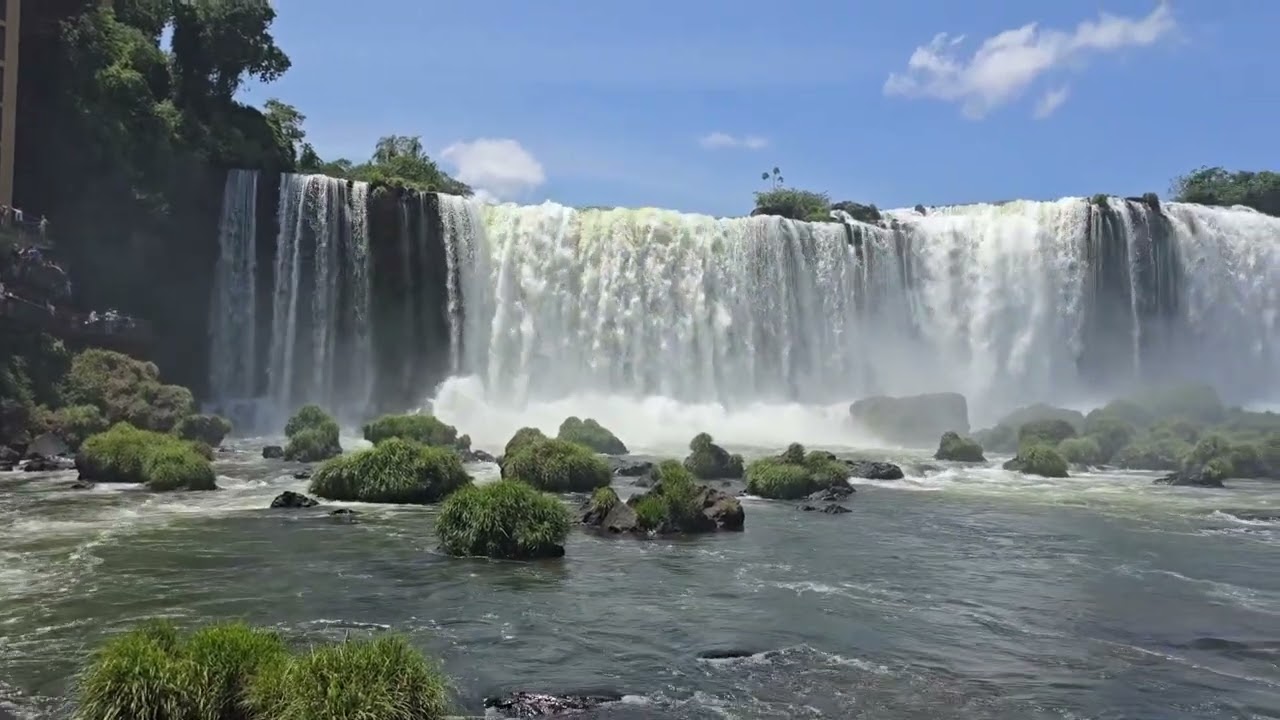
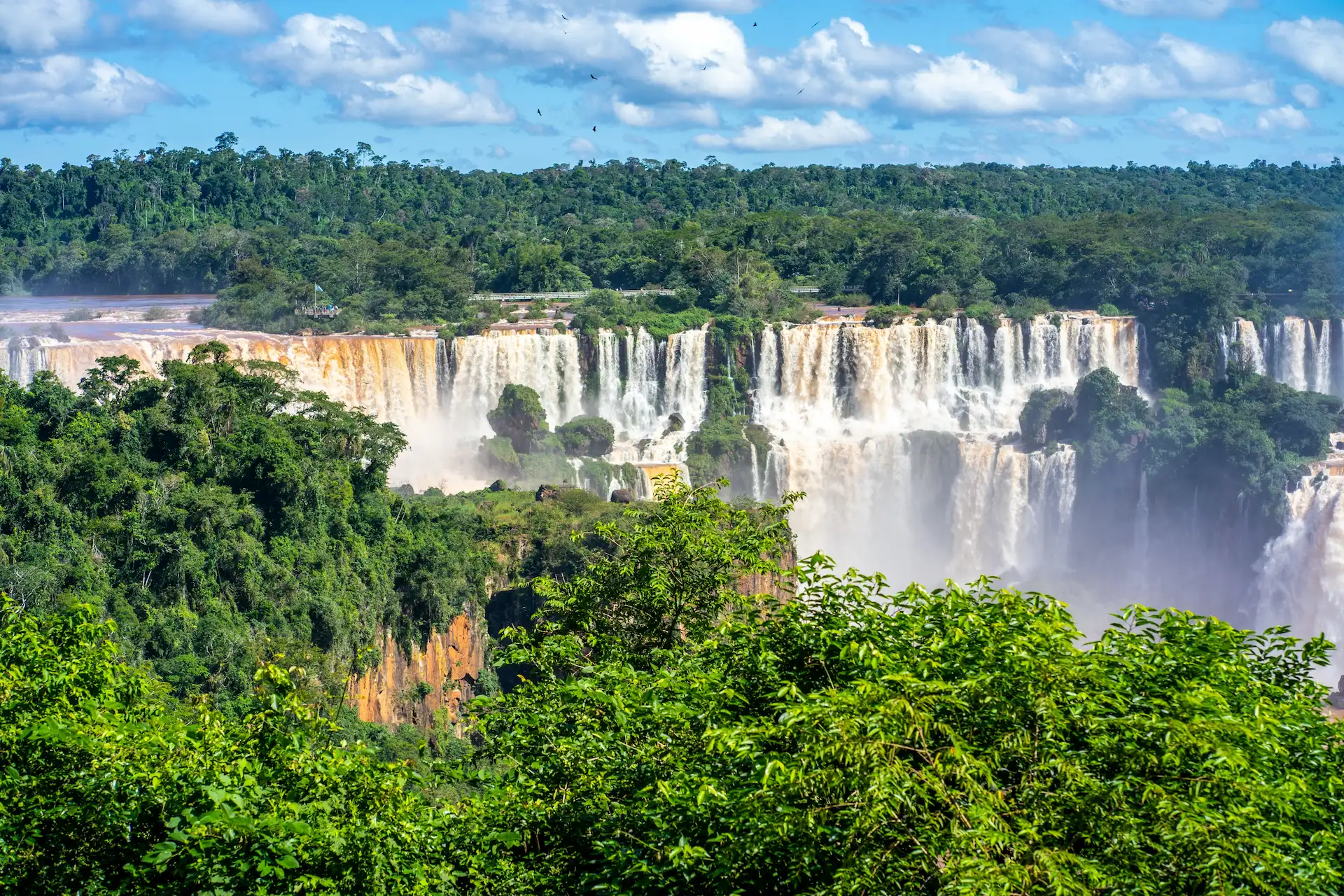
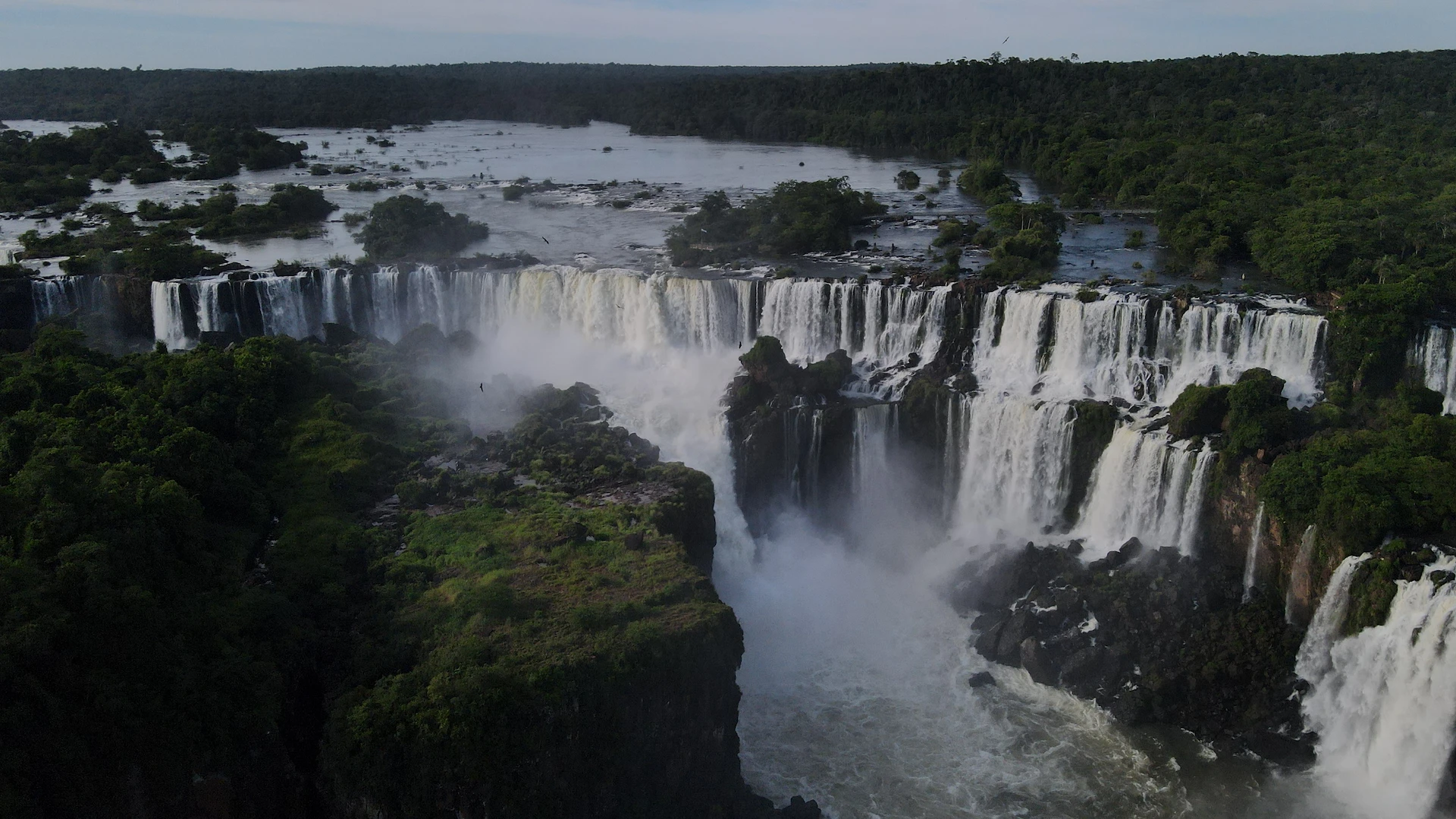
Brazil has fewer falls but the better view of them. A single panoramic trail of roughly 1.2 km runs along the canyon opposite the Argentine cataracts and ends on a walkway pushed out into the river below the Devil's Throat. This is where the photograph you have in your head comes from.
It is a shorter visit — half a day is usually enough — which is why it pairs well with an afternoon flight or with the bird park next door. Bear in mind it is a separate country: you cross an international border to get there, and at the time of writing U.S. passport holders need a Brazilian e-visa — we confirm what your own passport requires when we quote.
48 questions, answered straight. If yours is not here, write to us and we will answer it personally — and probably add it to this page.
The Iguazú Falls are the largest waterfall system in the world by number of drops — roughly 275 separate waterfalls spread along about 2.7 kilometres of the Iguazú River, on the border between Argentina and Brazil.
They were named one of the New7Wonders of Nature on 11 November 2011, and both national parks are UNESCO World Heritage Sites — the Argentine park since 1984, the Brazilian since 1986. What makes them different from other great waterfalls is that you walk among them for hours, inside subtropical rainforest, rather than viewing a single drop from a platform.
Iguazú is far wider than Niagara and roughly half again as tall. The falls stretch about 2.7 km and drop between 60 and 82 metres; Niagara is around 1 km wide and about 51 metres high.
Victoria Falls in Africa forms a single greater curtain of water. Iguazú is not one waterfall but a whole system of them, arranged in steps through the jungle, which is why it takes a day to walk rather than an hour to look at.
Yes — and of every destination we sell in Argentina, this is the one travellers most often name as the highlight of the trip. We would not phrase it that strongly if it were not what people write to us afterwards.
The honest caveat is about time, not about the place. Travellers who give Iguazú one rushed night sometimes come away underwhelmed. Travellers who give it two full days almost never do. If you are weighing up whether it justifies the internal flight from Buenos Aires: it does.
The falls sit on basalt laid down by enormous lava flows about 130 million years ago, during the Cretaceous, as South America and Africa pulled apart. Those flows formed the horizontal rock layers of the Serra Geral Formation across southern Brazil and northeastern Argentina.
The Iguazú River now runs over three of these basalt layers, which erode at different rates. That is what gives the falls their staircase shape and why there are hundreds of separate drops instead of one.
The first European to record them was the Spanish explorer Álvar Núñez Cabeza de Vaca, in 1541, during his overland journey from the Brazilian coast to Asunción. He named them the Saltos de Santa María.
"Discovered" is the wrong word, of course. The Guaraní had lived with these falls for thousands of years before that, and the name is theirs: y guasú, big water.
The Iguazú River, which rises in the Serra do Mar in Brazil, near Curitiba, and runs west for around 1,300 km before dropping over the falls and joining the Paraná a short distance downstream.
That is why the flow varies so much through the year: it depends on rain falling hundreds of kilometres away, not on the weather where you are standing.
The falls themselves lie between Argentina and Brazil only. They are on the Iguazú River, which forms the border between the Argentine province of Misiones and the Brazilian state of Paraná.
Paraguay does not have any part of the falls, and you cannot see them from Paraguay. The confusion comes from the Triple Frontier: Paraguay's Ciudad del Este sits about half an hour from Puerto Iguazú, where the Iguazú meets the Paraná. It is close to the falls, but not on them.
No. Swimming is not permitted anywhere in the falls or the river around them, and it would be extremely dangerous — the currents above the drops are lethal and the rock is undercut.
The way you get into the water here is the boat ride, which takes you under the spray at Salto San Martín. Some hotels in Puerto Iguazú have pools, and there are river beaches elsewhere in Misiones, but not at the falls.
Neither is better — they show you different things, and if you can, see both. The Argentine park contains about 80% of the 275 waterfalls and its walkways put you directly above and below them, including the Devil's Throat. The Brazilian park has fewer falls but the panoramic view of the entire cataract, which is the image most people picture when they think of Iguazú.
If you genuinely only have one day, choose Argentina — there is far more to walk and see, and the Devil's Throat catwalk is on that side.
Two full days is the right answer for most travellers: one for the Argentine park, one for the Brazilian park. In practice that means two or three nights in Puerto Iguazú.
One day covers the Argentine side properly and nothing else. Three days adds the boat ride, the Macuco trail or the Jesuit ruins of San Ignacio. Less than one full day is not worth the flights.
It is possible, but we advise against it — and we will say so when you ask us to quote it. Each side is a separate national park in a separate country, with its own entrance, its own trails and an international border crossing in between. Doing both in a day usually means seeing neither properly and spending a good part of it queueing at immigration.
The one case where it works is a tight connection — arriving one morning and flying out the next afternoon — where the alternative is missing a side entirely.
March, April, August and September are the best months — a good balance of strong water flow, comfortable temperatures of roughly 20–30 °C, and manageable crowds.
The falls are impressive in every month of the year. Water levels are highest in the summer rains and lowest towards the end of winter, but there is never a month when there is nothing to see.
Avoid January and February — the Argentine and Brazilian school holidays overlap, it is hot and humid, and the walkways are at their busiest. Easter week and the July winter holidays are the other two peaks.
The quietest comfortable windows are late March into April, and late August into September. Whatever month you come, the single most effective thing you can do is be at the park gates for 8:00 opening: the first two hours are calm, the light on the Upper Circuit is at its best, and you reach the Devil's Throat before the coaches.
Park entrance is not included in our packages — it is a national park fee, paid at the gate on the day, and each of the two countries charges its own. Both parks accept cash and Visa or Mastercard.
Two things worth knowing. First, foreign visitors pay a higher rate than Argentine residents, which is set by the national parks authority, not by us. Second, and much more useful: on the Argentine side a second consecutive day costs 50% of the first, as long as you validate your ticket before you leave the park on day one and return within 72 hours. Almost nobody tells you that, and it changes the maths if you were thinking of two days in the Argentine park.
The amounts move with Argentine inflation, so rather than publish a figure that goes stale we confirm the current fee for both parks when we send your quotation.
Yes — two full days is the right amount for most travellers, and it is what we recommend. One day for the Argentine park, one for the Brazilian. That covers the Devil's Throat, both circuits, the panoramic view and the border crossing without rushing.
Add a third day only if you want the boat ride under the falls, the Macuco jungle trail, the bird park or the Jesuit ruins of San Ignacio. And if you can only manage one day, spend it on the Argentine side.
Enough to fill a third day comfortably. The Gran Aventura boat ride under the falls, the Macuco trail through the jungle to the Arrechea waterfall, and the bird park beside the Brazilian entrance, which is genuinely good and works well with children.
Further out there are the Jesuit ruins of San Ignacio Miní, a UNESCO World Heritage site about two hours away, the Wanda gemstone mines, and the Itaipú dam on the Brazilian side. Tell us which of these appeals and we build the day around your park visits.
We recommend Puerto Iguazú, on the Argentine side. It puts you closest to the park you will spend the most time in, it lets you be at the gates for opening, and crossing to Brazil for a half day is straightforward.
Foz do Iguaçu is a bigger city with more hotel choice, and makes sense if you are continuing into Brazil afterwards. There are also hotels inside each national park, which buy you an early start at a premium. Tell us your onward plans and we will advise honestly rather than by default.
A valid passport for Argentina, and a passport plus a visa for the Brazilian side — and we confirm your exact requirements in writing before you travel.
Entry rules for Brazil depend on your nationality, and they do change: Brazil has both introduced and lifted visa requirements for travellers from the United States, Canada and Australia over the past few years. As of August 2026, holders of United States passports need a Brazilian e-visa to enter Brazil, including for a single day at the Brazilian park. It is applied for entirely online, with no interview, costs around USD 80.90, and processing takes about five working days. Apply only through the official government portal.
Because this is exactly the kind of rule that moves with a change of government, we check it against the official source for your nationality and your travel dates when we send your quotation, and we confirm it in writing. Argentina requires no visa from U.S. tourists.
Most Western travellers do not need a visa for tourism in Argentina. Citizens of the United States, Canada, the United Kingdom, Australia, New Zealand and the European Union enter as tourists with a valid passport.
Requirements do change, and they depend on your nationality rather than on where you are flying from, so we confirm your specific case in writing when we quote your trip.
Yes. Crossing to the Brazilian side is an international border crossing over the Tancredo Neves bridge, with Argentine exit and Brazilian entry formalities. Carry the actual passport, not a photocopy, plus any visa your nationality requires.
You do not need it inside the Argentine park, so leave it in the hotel safe on that day if you prefer.
You can. The Triple Frontier meets at Puerto Iguazú and Ciudad del Este is about half an hour away, though it is a shopping trip rather than a sightseeing one, and it is a third border with its own entry rules.
One thing worth knowing: Paraguay may ask for proof of yellow fever vaccination if you arrive from or transit through Brazil. Tell us if you want it in your itinerary and we will build it in properly.
The Argentine park opens at 8:00 every day of the year and closes at 18:00. Last admission is around 16:30, and the last Ecological Jungle Train up to the Devil's Throat station leaves at roughly 15:30.
The Brazilian park opens later — broadly around 9:00 on weekdays and 8:30 at weekends, with last entry at about 16:00. Hours on both sides shift for holidays, weather and maintenance, so we reconfirm them for your exact dates.
The Garganta del Diablo is the largest single feature of the falls: a horseshoe-shaped chasm where a great part of the river drops at once, throwing spray high enough to be seen from far off. You reach it on foot along a 1.1 km catwalk across the upper river, from a station served by the jungle train.
The walkway is open. It was rebuilt after flood damage and reopened in July 2024. It can still be closed at short notice when the river runs at flood level — a safety decision taken by the park, not by any operator. If that happens the rest of the park stays open, and we will tell you before you set out.
There are four main walks, and a full day covers the first three comfortably.
Upper Circuit — about 1.7 km of level walkway along the tops of the falls, looking down them. Lower Circuit — about 1.4 km descending through rainforest to see them from below, with the most spray and the best angle on Salto Bossetti. Devil's Throat — the train and the 1.1 km catwalk. Macuco Trail — 7 km return through the jungle to the Arrechea waterfall, for people who want forest more than crowds.
Expect five to eight kilometres of walking over a full day in the Argentine park, spread across several hours with plenty of stops. The walkways are metal grating, mostly flat, with stairs on the Lower Circuit.
The Upper Circuit and the Devil's Throat catwalk are largely accessible to wheelchair users; parts of the Lower Circuit are not. If anyone in your group has reduced mobility, tell us when you enquire and we will plan the day around what is genuinely doable rather than promising too much.
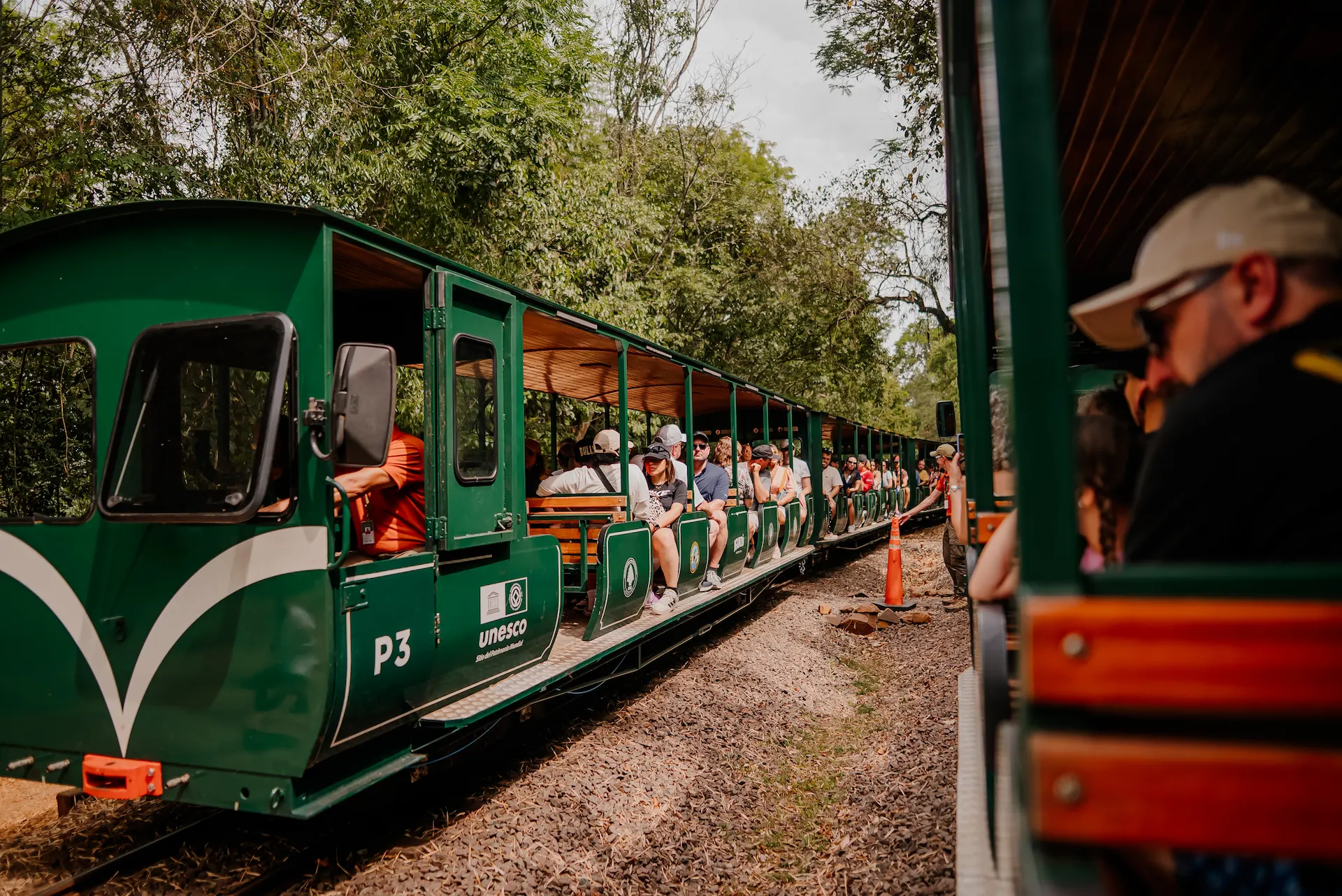
The Ecological Jungle Train is a narrow-gauge, open-sided train running from the visitor centre through the forest to the Devil's Throat station. It is how you reach the Devil's Throat catwalk, and it is included in park admission.
On busy days there is a queue for it, which is one more argument for arriving at opening.
Almost certainly. Coatis are everywhere — ring-tailed, inquisitive and entirely unafraid of people. You have a good chance of toucans, capuchin monkeys, lizards, enormous butterflies, and great dusky swifts nesting behind the falling water.
Please do not feed the coatis or leave food open. They bite and scratch when they smell a sandwich, and it is the most common minor injury in the park.
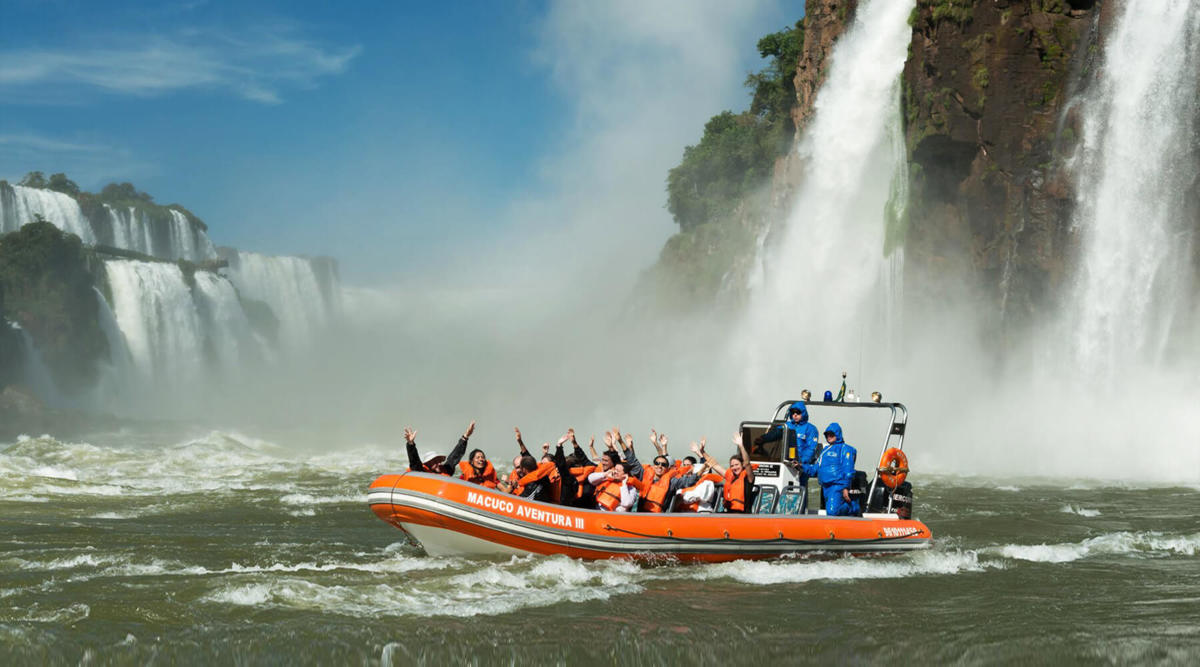
It is the optional adventure excursion inside the Argentine park, usually sold as the Gran Aventura: a truck ride through the forest, a descent to the river, then a rigid inflatable boat that runs upriver and in under the falling water, normally at Salto San Martín.
The boat section lasts around 20 to 30 minutes; the whole activity takes roughly two hours with the transfers. It is not included in park admission and is not part of our standard packages — tell us if you want it and we will add it to your quotation.
If you do not mind being soaked, yes — it is the one optional extra travellers thank us for most. Walking the circuits shows you the falls; the boat puts you underneath them, close enough that you stop hearing anything else. It is a genuinely different sensation, not a longer version of the same view.
Skip it if you are travelling with camera equipment you cannot get wet, if you would rather not do a steep descent and a rocking boat, or if your day is already tight — it takes about two hours out of your park time. We will tell you honestly whether it fits your itinerary.
You will be soaked from head to foot. That is not a marketing line: the boat goes deliberately under falling water and there is no dry seat on it.
Waterproof bags are provided for cameras, phones and dry clothes. Wear quick-drying clothes and shoes that do not mind water, bring a complete change and a towel — and do the Lower Circuit afterwards rather than before.
It is an energetic activity with a steep descent to the boarding point, heavy spray, noise and no way to stop halfway. Operators apply their own minimum age and health restrictions, and those can change.
Tell us the ages of everyone travelling and any relevant medical conditions when you enquire, and we will confirm in writing whether your group can be booked on it. We would rather say no in advance than have you turned away at the river.
Fly. It takes under two hours from Buenos Aires to Cataratas del Iguazú International Airport, with departures from both Aeroparque (AEP), in the city itself, and Ezeiza (EZE).
There are long-distance coaches from Retiro terminal too, but they take somewhere in the region of eighteen hours. Our Iguazú packages include the return flights, all transfers and the hotel, so this is not something you have to solve yourself.
Almost always via Buenos Aires. You fly into Buenos Aires — there are direct services from Miami, New York, Atlanta, Houston and Dallas — and then take a short internal flight of under two hours to Cataratas del Iguazú airport.
Some travellers route in through São Paulo or Rio and reach the falls from the Brazilian side instead. That works, but it puts you into Brazil, with whatever visa Brazil requires of your nationality. Tell us where you are flying from and we will build the internal legs around your international ticket.
Yes, but not as a day trip. Rio to Foz do Iguaçu is roughly a two-hour flight, so you need at least one night at the falls — realistically two if you want to see both sides.
Coming from Rio you arrive on the Brazilian side. If you want the Argentine park as well, which is where about 80% of the waterfalls are, you cross the border for a day. Iguazú sits neatly between Rio and Buenos Aires, so a common route is Rio, then the falls, then Buenos Aires and Patagonia — we plan the whole sequence if you tell us your dates.
Cataratas del Iguazú International Airport (IGR) for the Argentine side, and Foz do Iguaçu International Airport (IGU) for the Brazilian side. They are about 40 minutes apart, with an international border between them.
If you are travelling within Argentina, fly into IGR. Flying into Brazil and crossing means you clear immigration twice and need whatever visa Brazil requires of your nationality, even if you only intend to sleep on the Argentine side.
Cataratas del Iguazú airport sits between the two: a short drive from the national park entrance and around twenty minutes from the hotels in Puerto Iguazú.
All our packages include private transfers in both directions, so someone is waiting at arrivals with a sign with your name on it. If you have booked your own flights and only need the transfers, we can arrange those too.
Comfortable closed shoes with grip, light quick-drying clothes, a light waterproof, a hat and sun cream. The walkways are wet metal grating, the humidity is high and there is very little shade on the Upper Circuit.
Skip the umbrella — it is useless in the spray and awkward on a narrow catwalk. Bring a dry bag or even a plastic bag for your phone even if you are not doing the boat, because the spray at the Devil's Throat reaches everything. Add insect repellent, and more water than you think you need.
It is recommended, but neither Argentina nor Brazil requires it for entry. Both the U.S. CDC and the UK FCDO advise yellow fever vaccination for travel to the Iguazú region, including short one- or two-day visits. The vaccine must be given at least ten days before travel to be effective.
One practical exception: Paraguay may require proof of vaccination if you arrive from or transit through Brazil. We are a travel agency and not a medical service — please confirm with a travel health clinic or your doctor. This is guidance, not medical advice.
No. There is no malaria risk at Iguazú, and antimalarial tablets are not needed.
Dengue is present in the region year-round and there is no widely available traveller's vaccine, so the sensible precaution is the ordinary one: repellent containing DEET, long sleeves at dawn and dusk, and covering up in the forest. Mosquitoes are noticeably fewer in the drier months from May to September.
The parks stay open, and rain is not a reason to change your plans. This is subtropical rainforest — rain is part of the place, it usually passes quickly, and the falls are at their most powerful afterwards. Bring a light waterproof rather than an umbrella.
The one weather situation that does change things is a major flood, which can close the Devil's Throat catwalk on safety grounds. We monitor it and tell you before you go out.
Municipal water in Puerto Iguazú is treated and meets Argentine standards, but taste and clarity vary, particularly after heavy rain. Most visitors and many locals drink bottled or filtered water, and that is what we would suggest.
Cards are accepted at hotels, restaurants and the park facilities, and there is an ATM inside the Argentine park. Carry some cash anyway — for tips, small purchases, market stalls and the times a card terminal is offline.
If you cross to Brazil for the day, remember it is a different currency. For a single day, a card is usually the simplest answer.
Puerto Iguazú is a small tourist town and is generally comfortable to walk around, including in the evening in the central area. The ordinary precautions of any destination apply: keep valuables out of sight, use the hotel safe, and use arranged transport at night rather than walking unfamiliar routes.
Inside the parks the real hazards are the mundane ones — wet walkways, sun, dehydration and the coatis.
Yes. Both parks are set up for independent visitors — you buy an entrance ticket, walk the circuits at your own pace and take the train. You do not need a guide inside the Argentine park, and it is not compulsory.
What people book us for is everything around that: the internal flights, the transfers timed to park opening, the hotel, the border crossing to Brazil and someone to call when a flight moves. If you only want the logistics and would rather walk the park alone, say so — we will quote it that way.
Yes. Every tour we sell at Iguazú can be quoted as a private service — your own vehicle, your own guide and your own pace, rather than sharing a coach with other travellers.
It costs more, and it is worth it in three cases: if you are a family or a group of four or more, where the difference per person narrows a lot; if anyone has reduced mobility and needs the day to move at their speed; or if you simply do not want to wait for eleven other people at every stop. Ask for both quotations and compare — we will send them side by side.
Because Iguazú has more moving parts than it looks: two national parks in two countries, internal flights that sell out in high season, an international border, entrance fees paid on the day, transfers timed around park opening, and visa rules that have changed more than once in recent years.
We are a registered Argentine travel agency — Legajo EVT 17869, ASTA member 900202085 — with an office in Buenos Aires and over twenty years arranging these trips. One person builds your whole itinerary and answers you directly: not a call centre, not a chatbot, and not an overseas platform reselling a local operator.
Within 24 hours, and quotations are free with no obligation. Send us your dates, how many of you are travelling and roughly what you want to see.
You will get a quotation and honest advice on the itinerary — including being told if we think you have allowed too little time, which is the most common thing we end up saying about Iguazú.
Yes, and it is what we do best. Iguazú sits naturally at the start of a longer trip with Buenos Aires and Patagonia — our 11-day Best of Argentina and the 14-day version with Ushuaia both begin at the falls and finish at the glaciers.
It also combines well with Salta and Jujuy in the northwest. Tell us how many days you have and we will build the route around your international flights.
The travellers who come back disappointed from Iguazú are nearly always the ones who gave it a single night. They land in the afternoon, walk the Argentine park the next morning with an eye on the clock, and fly out having seen a great deal of water and very little of the place.
The ones who come back calling it the best thing they did in South America gave it two full days. One on top of the falls in Argentina, one standing back from them in Brazil. Same flights, same hotel, one extra night — and that is the difference between ticking Iguazú off a list and actually being there.
If your dates are tight and two days genuinely will not fit, say so when you write to us. We will tell you which single day to choose and how to get the most out of it, rather than selling you something that will not work.
Free quotation within 24 hours, with honest advice on how many days you actually need — and written confirmation of exactly what your passport requires for the Brazilian side.
Every Iguazú tour we run, from a three-day break to the falls inside a longer Argentina itinerary.
See all Iguazú tours →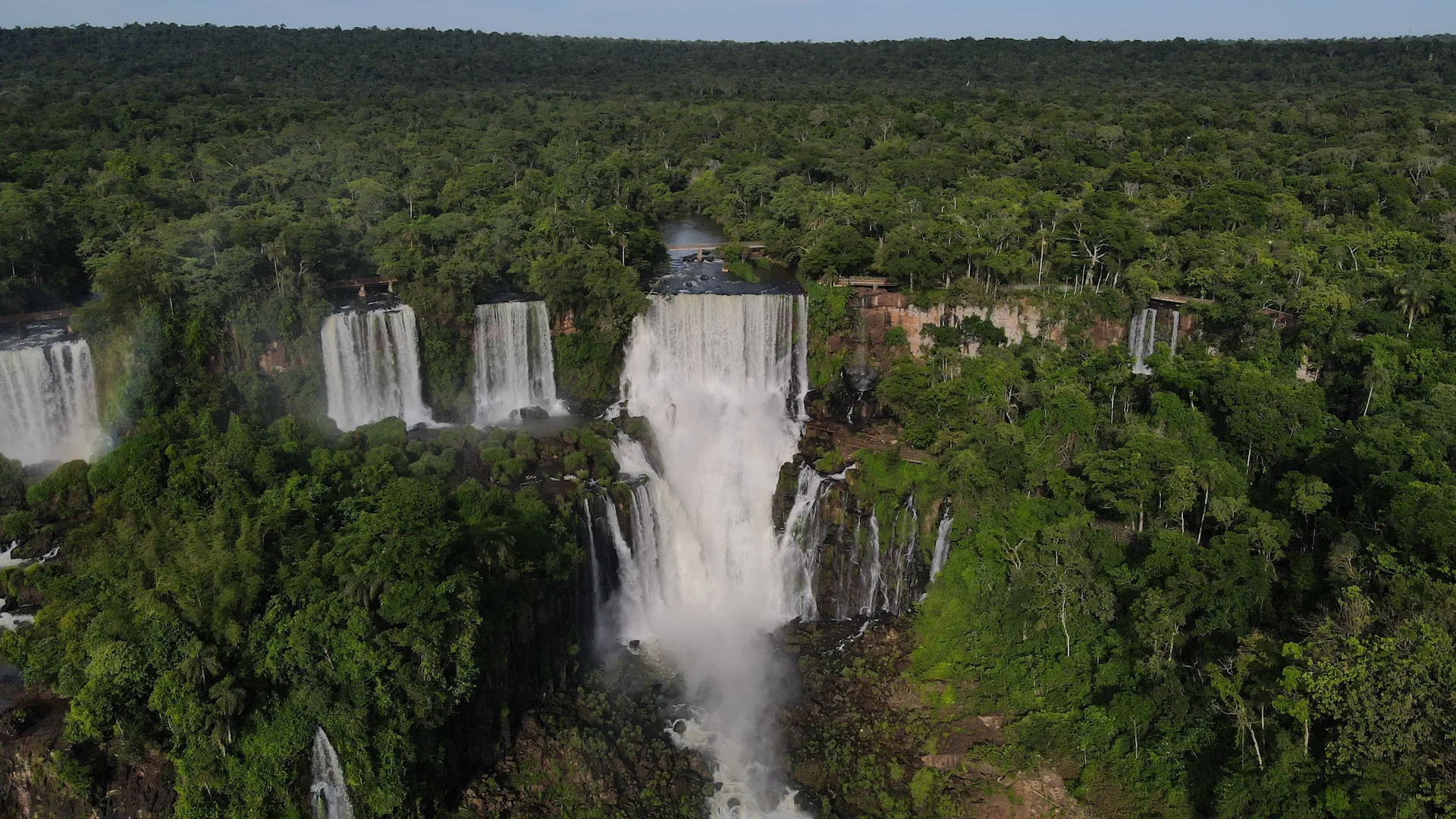
Return flights from Buenos Aires, two nights with breakfast, transfers and both sides of the falls.
More information →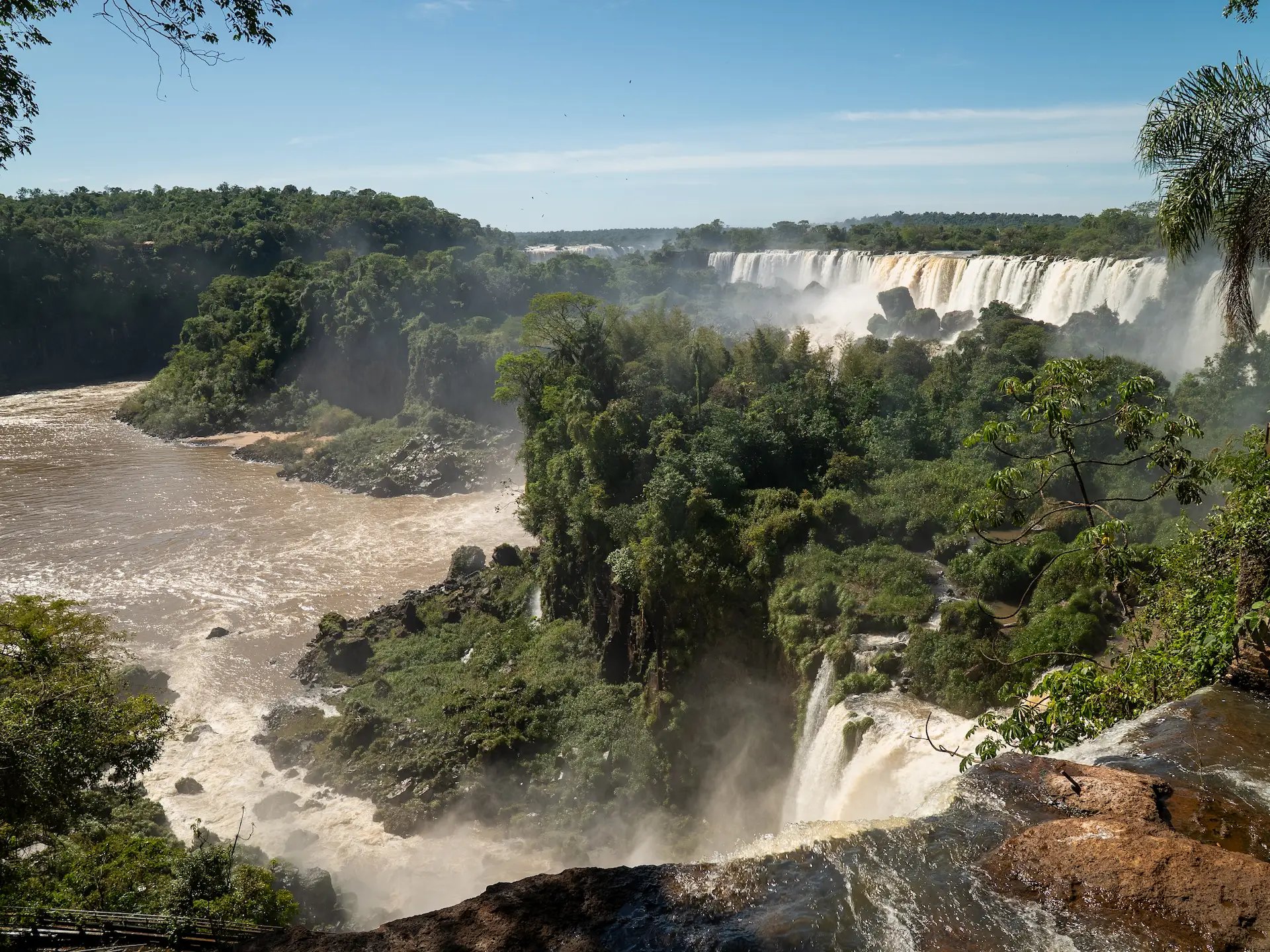
Iguazú, Buenos Aires and Patagonia with the Perito Moreno Glacier, in a single trip.
More information →