Six hours east along the Beagle Channel to Isla Martillo, where more than ten thousand Magellanic penguins and a small colony of Gentoos come ashore to breed. You watch them from the boat. Nobody lands — and this page explains exactly why, because almost nowhere else does.
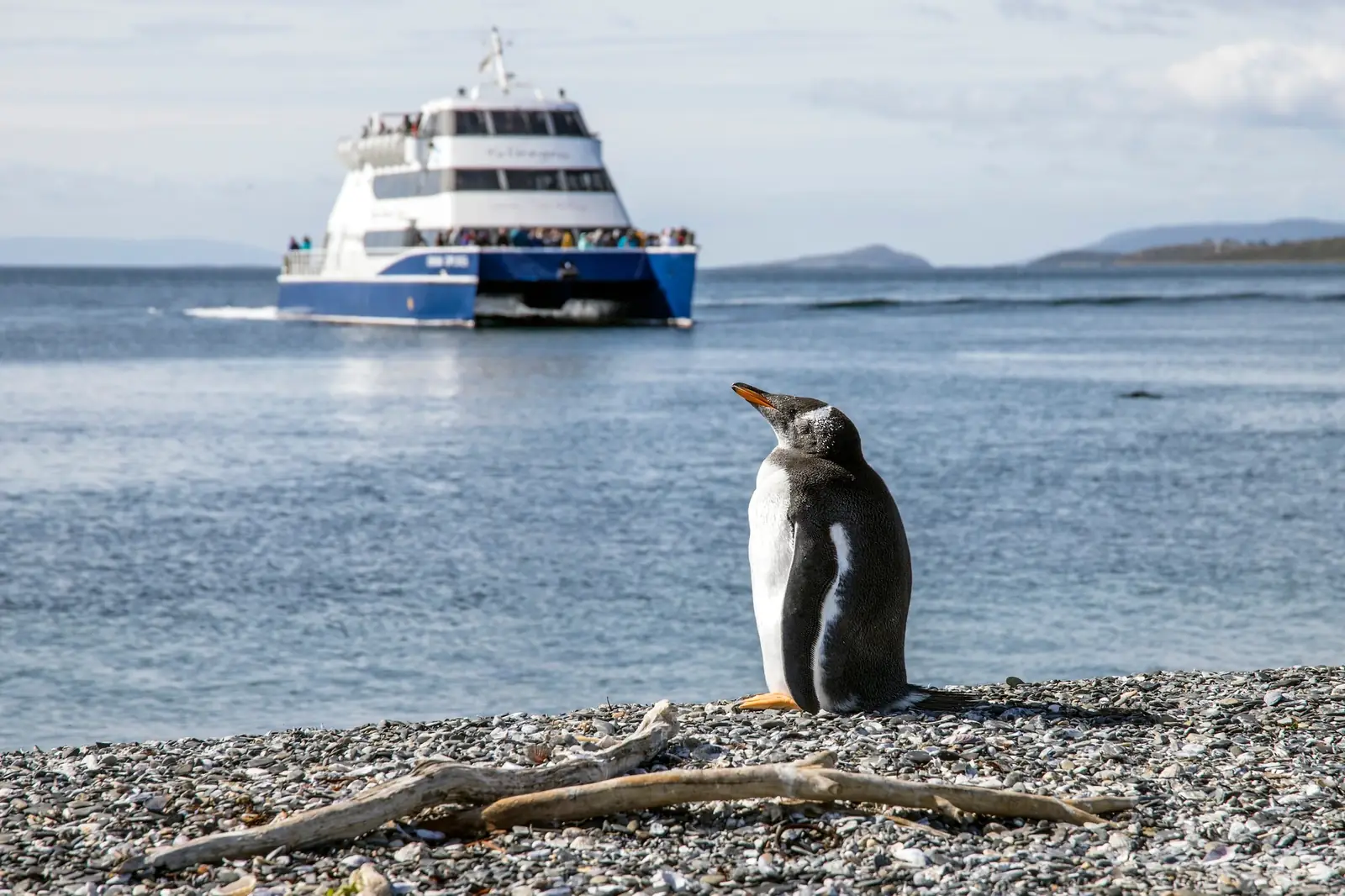
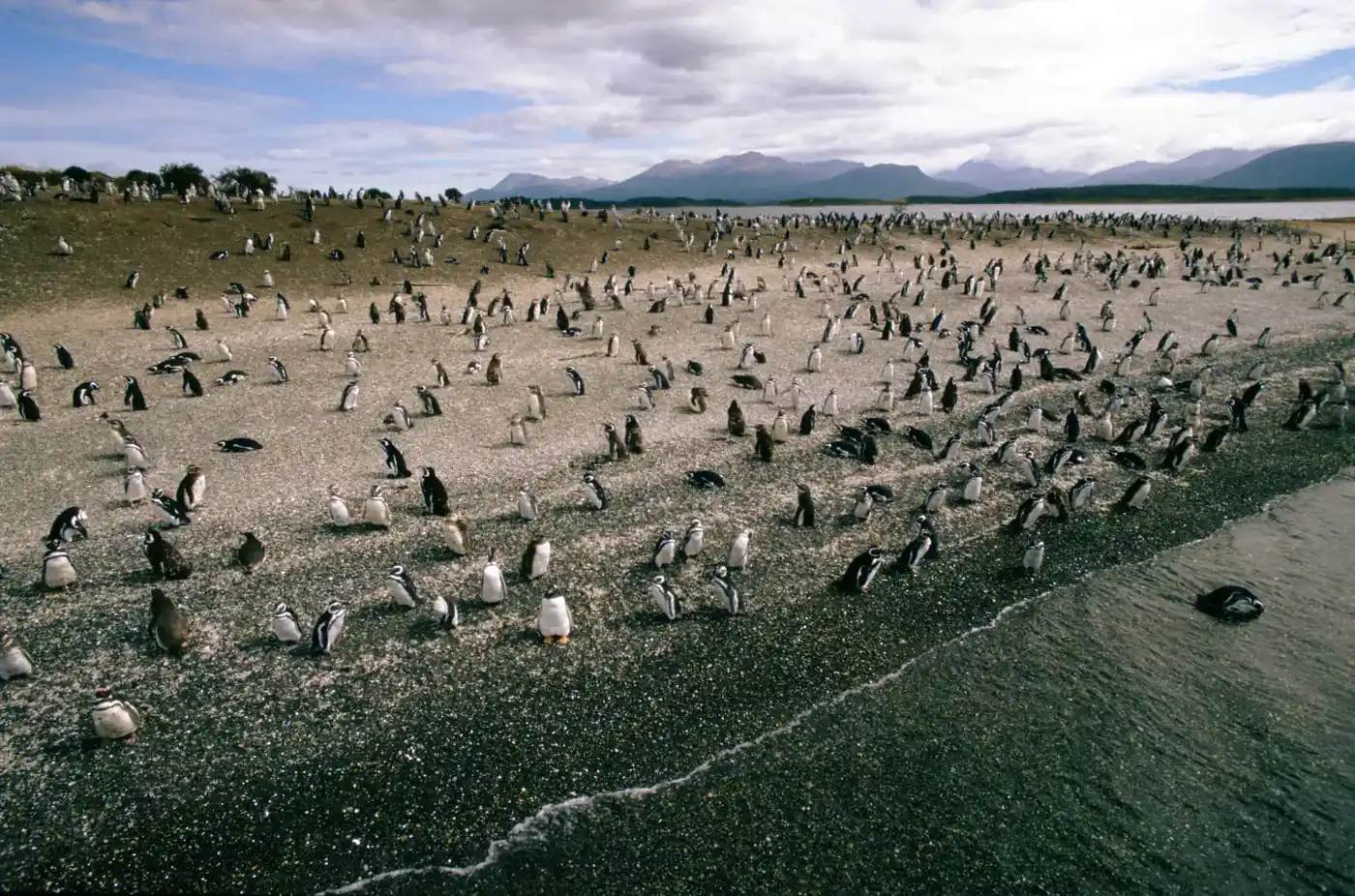
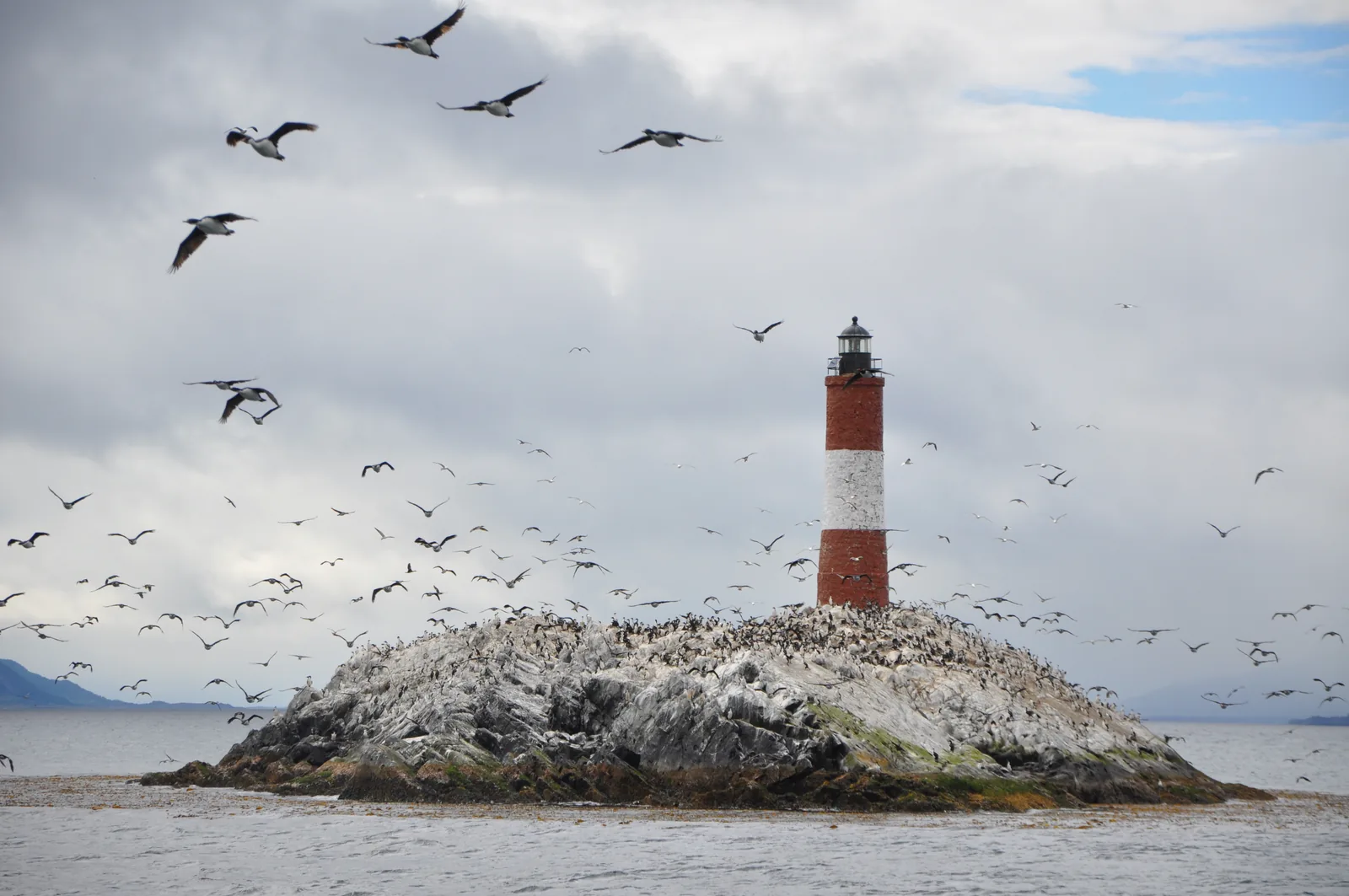
From the pier in the centre of Ushuaia to a gravel island with ten thousand penguins on it.
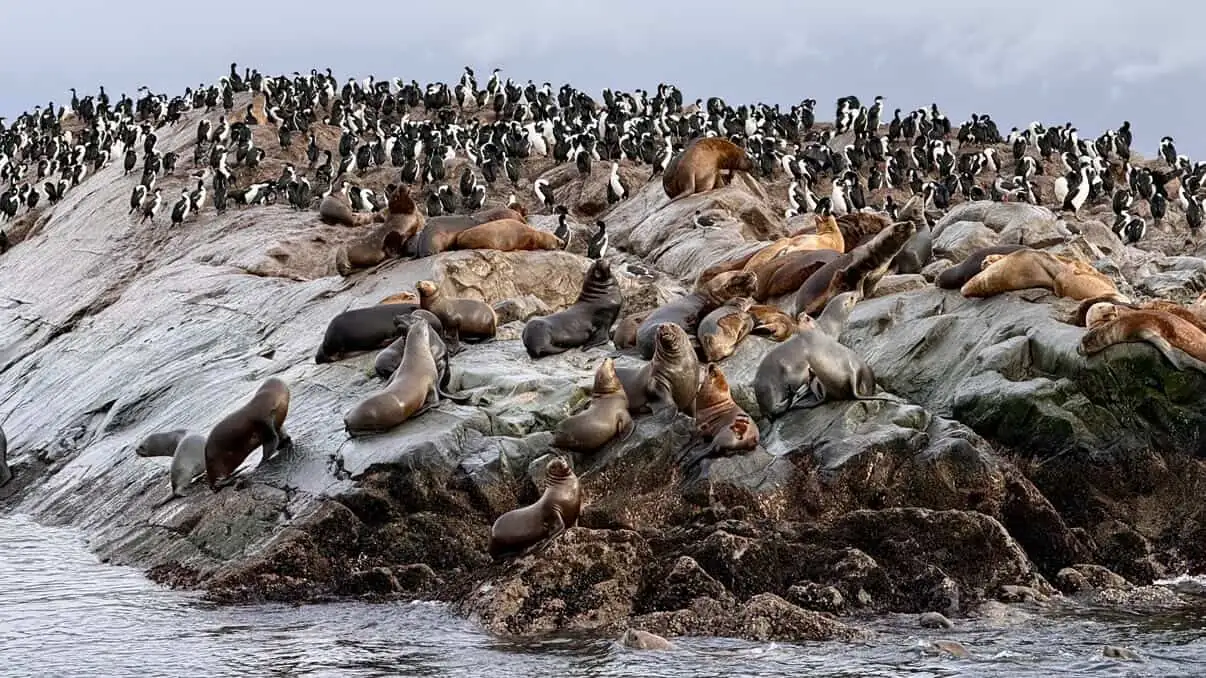
You board at the tourist pier in the centre of Ushuaia and the catamaran works its way out across the bay. The first stops are the ones every Beagle Channel boat makes, and they are worth the trip on their own: a colony of South American sea lions hauled out on bare rock, and rookeries of imperial and rock cormorants packed onto the ledges above them.
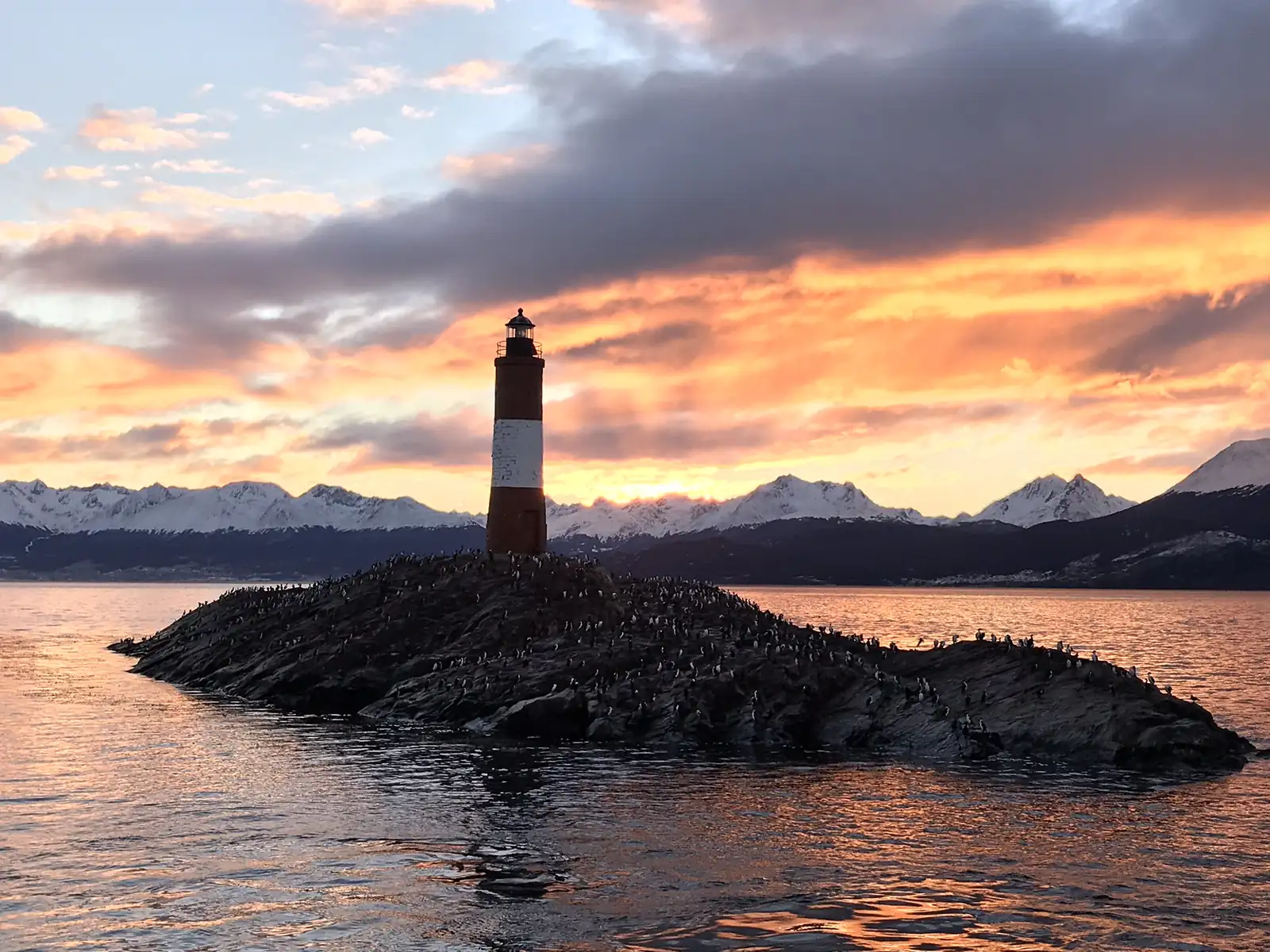
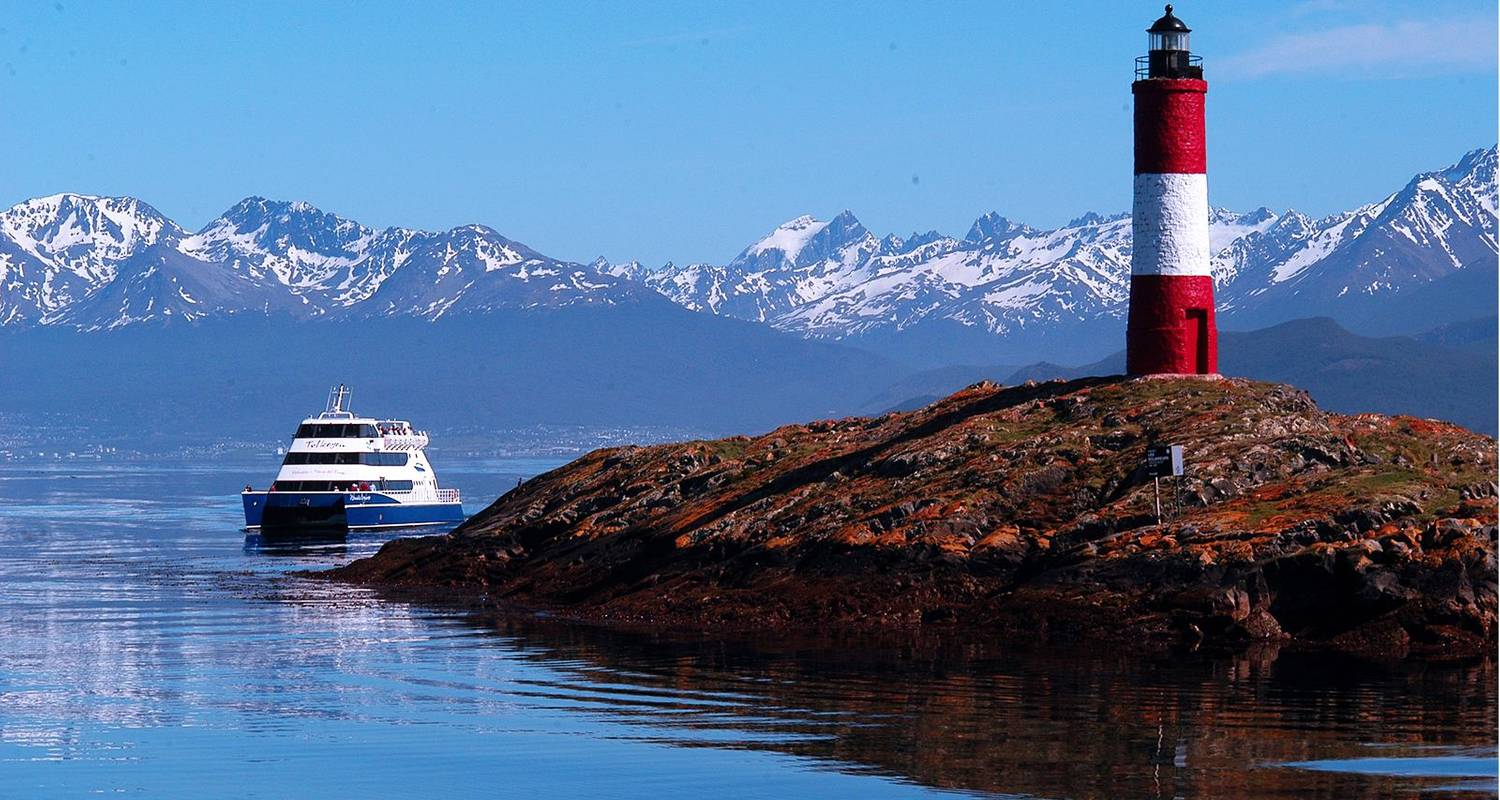
Then the Les Éclaireurs lighthouse, the red-and-white tower on its islet that appears on every postcard of Ushuaia. Here is a small thing almost every tour page gets wrong: this is not the “Lighthouse at the End of the World” from the Jules Verne novel. That one is San Juan de Salvamento, far away on Isla de los Estados. Les Éclaireurs was built in 1920 and is still working.
If you have booked one of the short three-hour channel cruises, this is where it turns around and goes home. The six-hour navigation keeps going east.
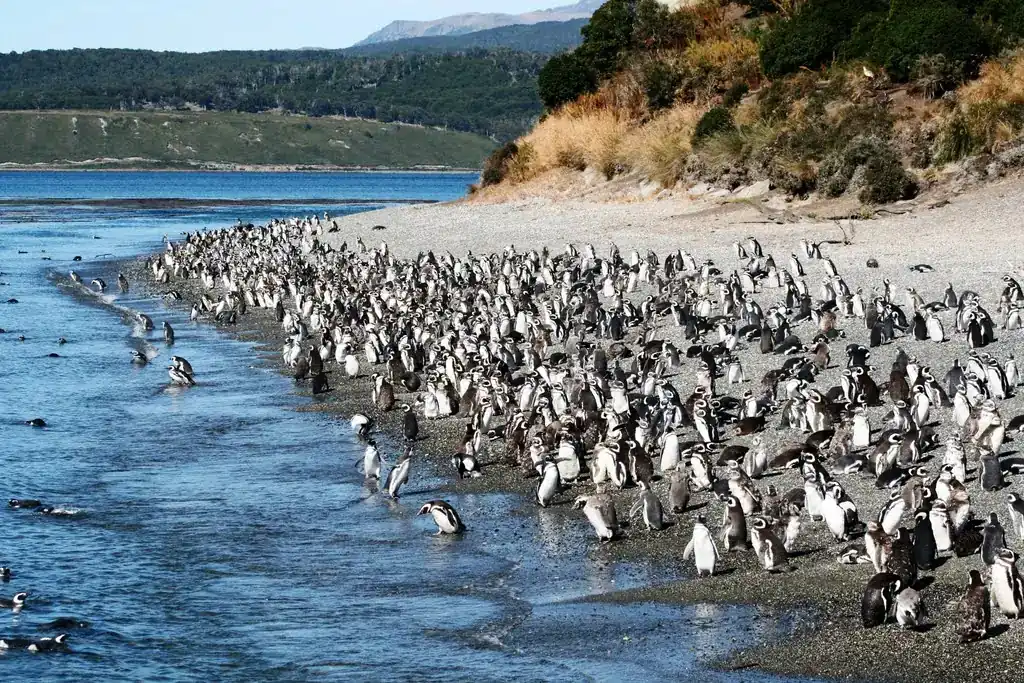
Isla Martillo is a low spit of gravel and shell about fifty-nine kilometres east of Ushuaia — worth stating plainly, because a surprising number of English-language pages claim fifteen, which is the distance from Estancia Harberton, not from town. It is thirty-two hectares, and the Yámana called it Yecapasela.
The main colony is Magellanic penguins — Estancia Harberton, which owns the island, puts it at more than ten thousand birds. They nest in burrows dug into the peat, some of them over a metre deep, and part of the colony nests inside the coastal forest, which is unusual for the species.
The rarity is the other one. Around a hundred Gentoo penguins breed here too, and Isla Martillo is the only breeding site for Gentoos on the South American mainland. They arrived in the mid-1980s and stayed. King penguins turn up occasionally in small groups — they do not nest here, so treat one as luck, never as a promise.
This is the question travellers actually type into Google, and the honest answer is not the one that circulates. It is not a government ban. Isla Martillo is private property — it belongs to Estancia Harberton, founded in 1886 and a National Historic Monument — and the estancia has licensed the landing to a single company. Harberton states this on its own website and adds that it does not control that company’s prices or availability.
The walking area on the island is roughly 800 square metres, staked out inside a live breeding colony that researchers at CADIC-CONICET have been monitoring for over two decades, with published guidance on keeping human disturbance down. The number of feet on that gravel is deliberately tiny.
The practical consequence: the landing sells out weeks or months ahead in high season, and it leaves from Harberton, ninety kilometres from Ushuaia by gravel road, not from the port. This navigation is what most travellers can actually book — same island, same two species, from the water.
40 minutes before departure
You present yourself at the ticket office at the Port of Ushuaia, in the centre of town, forty minutes before sailing. Transfers from your hotel are not included — the pier is walkable from most of the centre.
First 20 minutes
Out past the working port and the moored ships, with the town rising behind you against Monte Olivia and the Cinco Hermanos. It is the best view of Ushuaia there is, and it is free.
Sea lion colony
A rock covered in South American sea lions, close enough to hear them. The bulls are enormous and territorial and there is usually an argument going on.
Cormorants and seabirds
Imperial and rock cormorant rookeries, plus skuas, kelp geese, steamer ducks and, with luck, a black-browed albatross following the wake.
The postcard
The 1920 tower on its islet, still in service. The boat circles it so both sides of the deck get the shot.
About 1 hour 30
The long leg. Chile is off the starboard side the whole way, and the mountains do not stop. Heated saloon below, open deck above.
The penguin colony
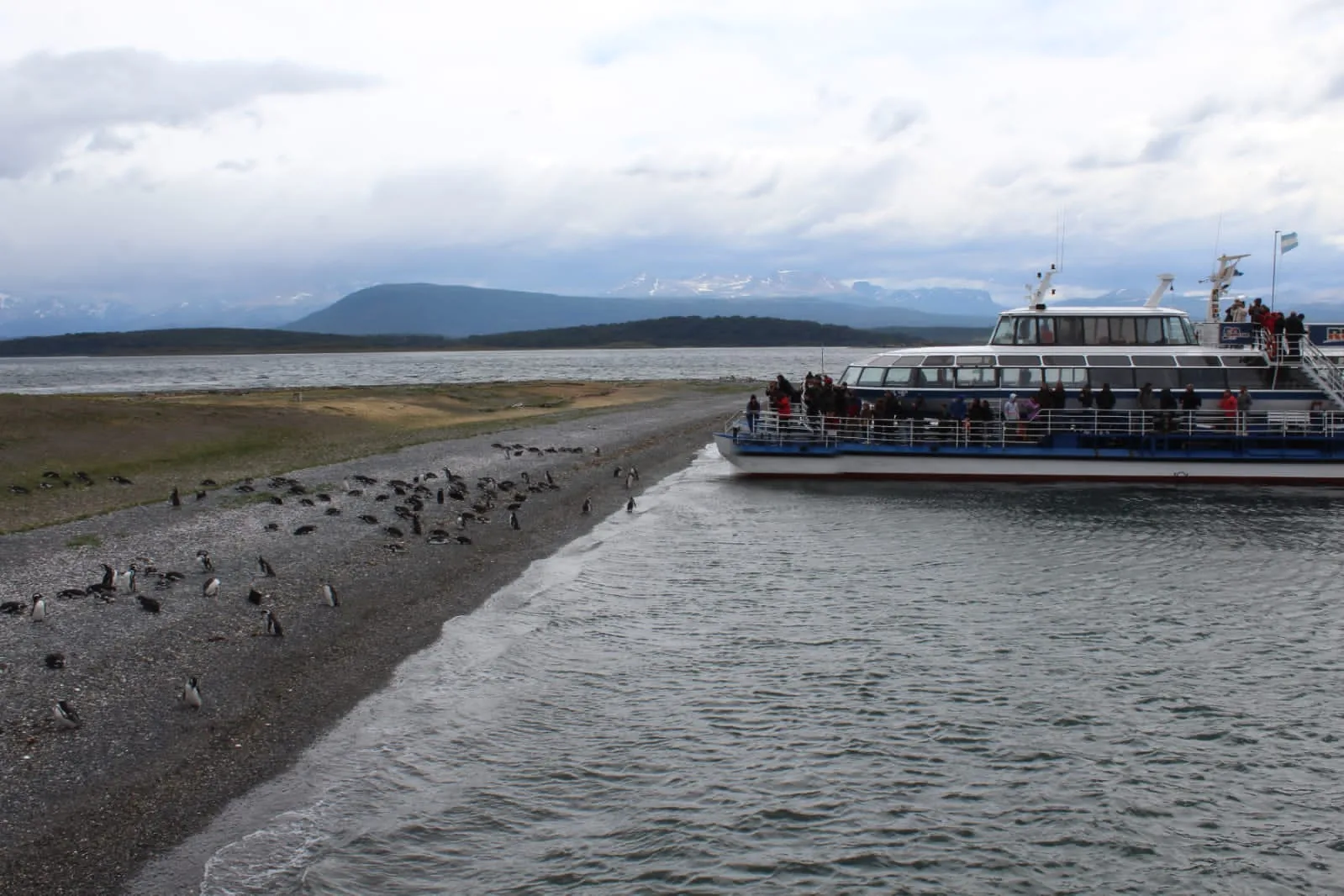
The boat comes in close to the beach and holds there so you can watch the colony without disturbing it. Magellanic penguins, the Gentoo group, and a great deal of coming and going between the water and the burrows. No landing.
About 6 hours after departure
The return leg, back to the tourist pier where you started. The 10:00 departure has you back mid-afternoon; the 15:00 gets you the low evening light on the way home.
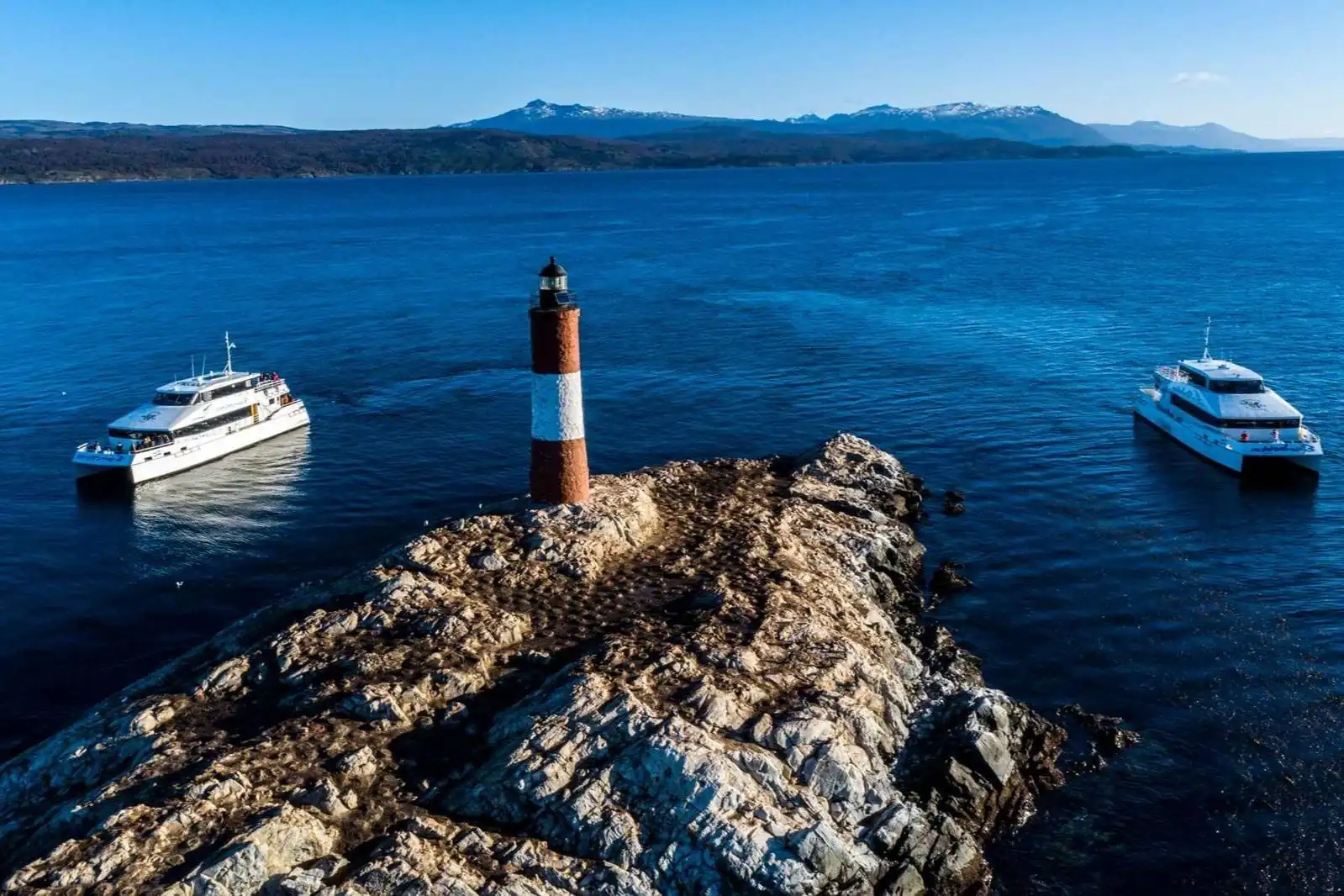
Les Éclaireurs from above. Both boats here are doing the short three-hour cruise — the penguins are another forty kilometres east of this rock.
Read the right-hand column carefully. The second line is the one that matters.
The walking tour on Isla Martillo runs on a tiny daily quota and routinely sells out weeks or months ahead in high season. This navigation runs twice a day from the town pier. You lose the walk, not the sighting.
Magellanic penguins in the thousands and the small Gentoo group, the only one breeding on the South American mainland. The boat comes in close to the beach and holds position; you will not need a telephoto lens.
The landing tour leaves from Estancia Harberton, ninety kilometres east of Ushuaia. This one leaves from the centre of town and brings you back to it.
Heated saloon, bar, toilets, and you stay aboard the entire time. No transfer into a small boat, no walking on uneven ground. If you are travelling with small children, with grandparents, or with anyone whose knees have opinions, this is the version that works.
The short Beagle Channel cruise turns around at the lighthouse and never reaches the penguins. If penguins are why you came, the three-hour trip is the one to avoid — and plenty of people book it by mistake.
Legajo EVT 17869, ASTA member 900202085, an office in Buenos Aires and over twenty years arranging trips across Argentina. One person answers you, start to finish.
No. On this navigation you watch the colony from the boat. The catamaran comes in close to the beach and holds position so the birds carry on as normal — and they do, walking down to the waterline a short distance from the hull.
We would rather you read that here than discover it at the pier. If walking on the island is what you want, read the next answer.
The reason is not what most pages say. It is not a government ban. Isla Martillo is privately owned by Estancia Harberton, and the estancia has licensed the landing to one single company. Harberton says so on its own website, and adds that it does not manage that company’s prices or availability.
The authorised walking area is about 800 square metres, staked out inside a live breeding colony that has been studied by CADIC-CONICET researchers for over twenty years. Keeping the number of people on the ground very small is the entire point.
If the walk is what you have your heart set on, tell us and we will point you in the right direction, even though it is not ours to sell. We would rather you got what you came for.
No. You will see the same island, the same colony and the same two species. What you lose is the walk, not the sighting.
This is the single most common situation we hear about. Travellers find out that a landing exists, go to book it, and discover the quota went weeks or months ago. It is worth saying plainly: the boat is not a consolation prize. It is how the overwhelming majority of people see the penguins of Tierra del Fuego, it leaves from the middle of town, and you spend six hours on the Beagle Channel instead of three of them in a vehicle.
Close enough to photograph the birds without specialist equipment. The catamaran noses in towards the beach and holds there while you watch.
We are deliberately not quoting you a number of metres or a number of minutes, because that depends on the tide, the wind and the day, and we are not going to promise something the sea decides. What we will say is that nobody comes back from this one saying they could not see the penguins.
Two species reliably. Magellanic penguins are the colony — Estancia Harberton, which owns the island, puts the population at more than ten thousand. They nest in burrows dug into the peat.
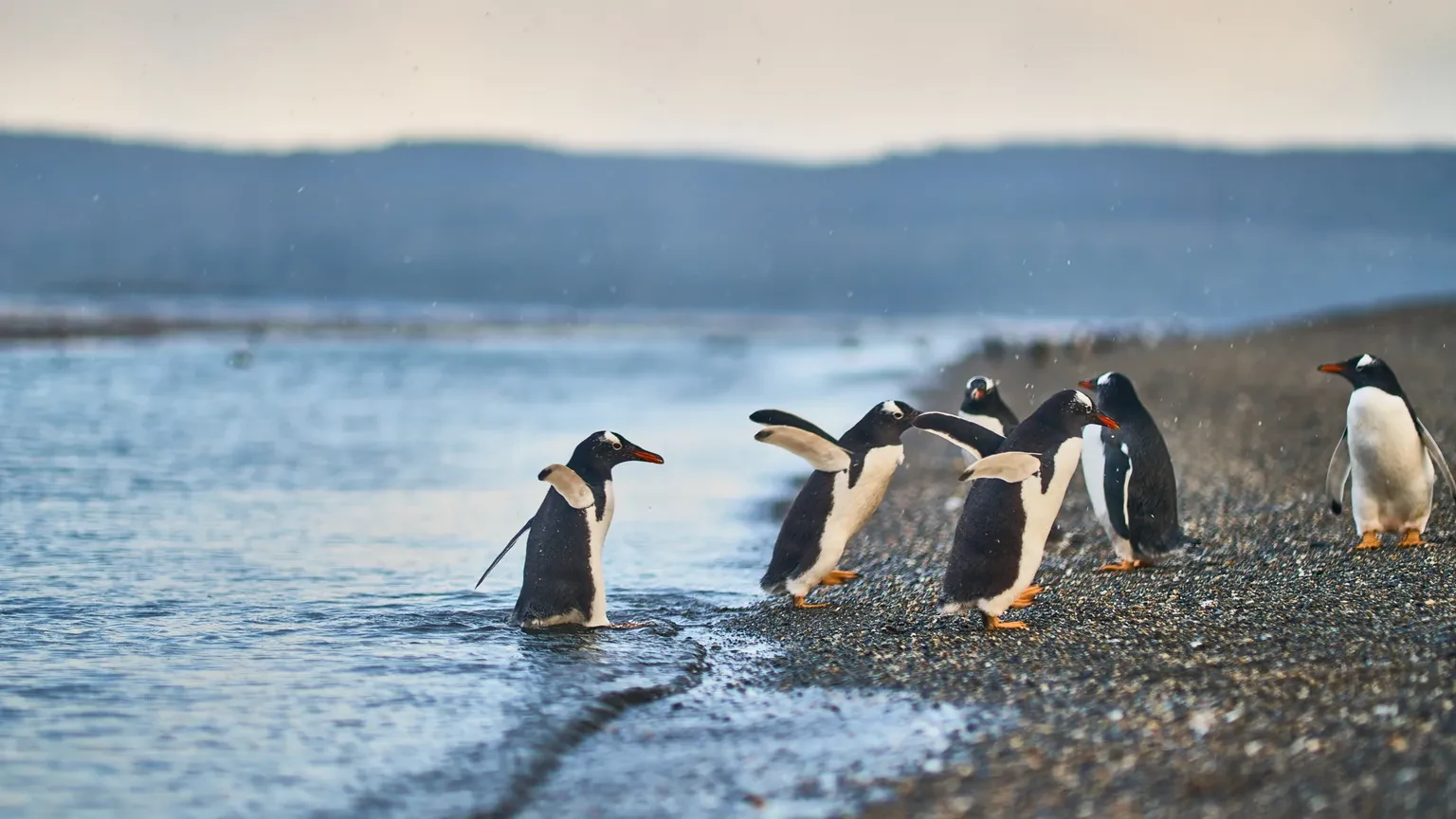
The rare one is the Gentoo: about a hundred birds, and Isla Martillo is the only place they breed on the South American mainland. They are the bigger ones with the orange bill and the white patch over the eye.
King penguins appear occasionally in small groups. They do not nest here. If you see one it is a genuinely lucky day, and we are not going to pretend otherwise.
The navigation runs from 1 November to early April. We confirm the exact closing date on your quotation, because it moves.
The Magellanic penguins arrive in September — the males first, to claim the burrows. The average laying date on Isla Martillo is 14 October, and chicks hatch mostly in the first three weeks of November, then are fed by both parents for seventy to a hundred days. So December to February is when the colony is at its busiest and the chicks are visible. From late February the birds moult and start to leave.
No, and this is the mistake we see most often. The short cruise is about three hours: it does the sea lions, the cormorants and the Les Éclaireurs lighthouse, then turns around. It never reaches Isla Martillo, because the island is another forty kilometres east.
The short one is a good trip and it is the one included in most package holidays. But if you booked it expecting penguins, you will not see any. If penguins are the reason you are going, you want this one.
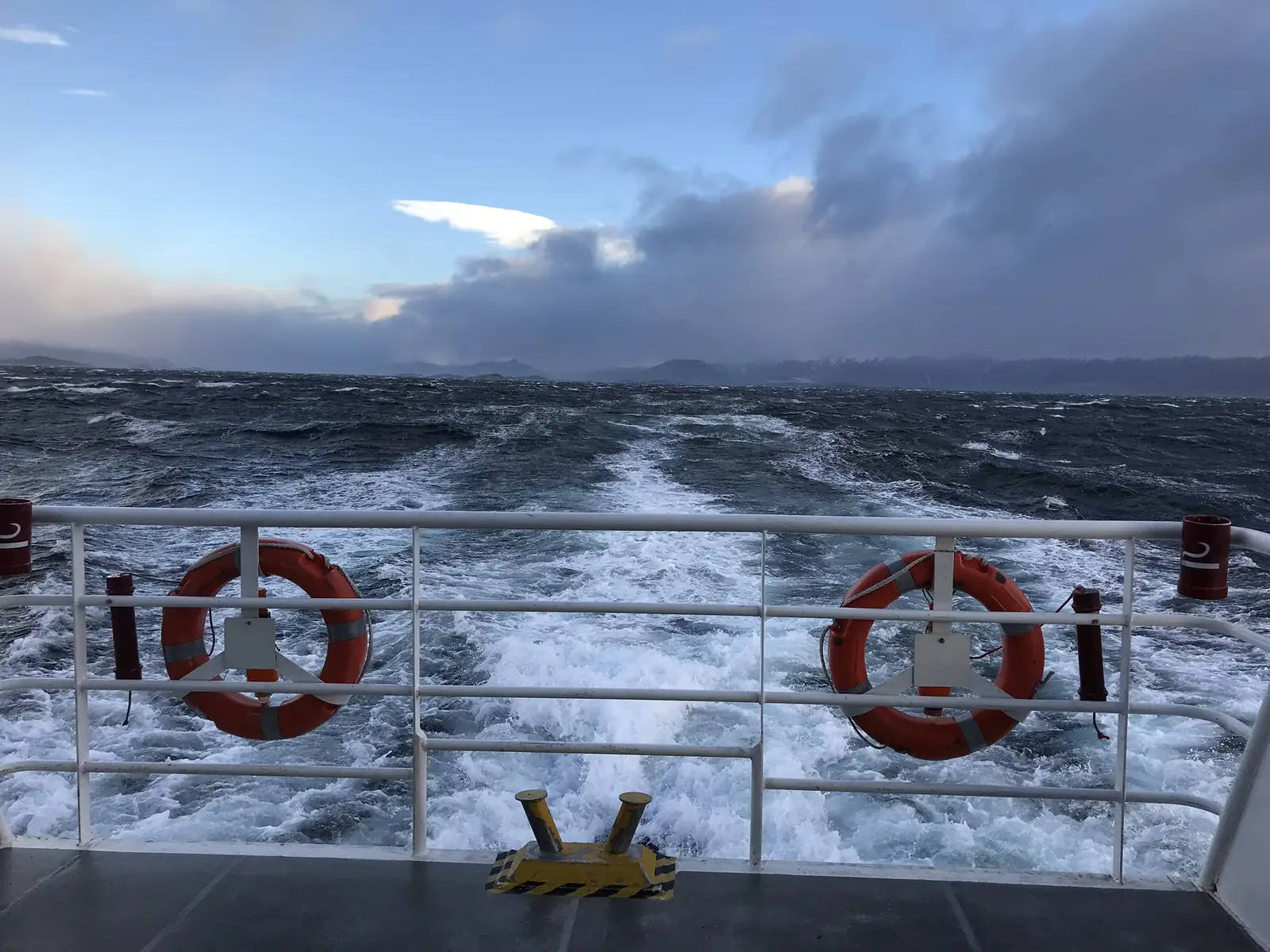
Sometimes, yes. The Beagle Channel is sheltered compared with open ocean, but Ushuaia gets serious wind and the port authority suspends sailings when it judges it necessary. It is not the operator being cautious for the sake of it.
If your departure is suspended you are rescheduled or refunded. Our practical advice: do not book this for the last afternoon before your flight. Leave yourself a spare day somewhere in Ushuaia and the problem disappears.
Yes, and it is one of the better options for a mixed group. You stay aboard the whole time. There is a heated saloon with seating and large windows, a bar and toilets, and an open deck for when you want the wind and the photographs.
Six hours is a long time for a very small child, so bring something to occupy them for the crossing. If anyone in your group has limited mobility, tell us when you enquire and we will confirm the boarding arrangements rather than guess.
A windproof jacket, whatever the forecast says, plus a hat and gloves even in January. It is always colder out on the water than it is in town, and the good viewing is on the open deck.
Also: sunglasses, sunscreen (the light off the water is fierce), a spare camera battery because the cold drains them, and something for seasickness if you are prone to it — the channel is usually calm, but “usually” is doing some work in that sentence.
Almost every disappointed review of a Ushuaia penguin trip comes down to the same thing, and it is not dishonesty on anyone’s part. It is that two quite different products share one keyword. There is a navigation that takes you to the colony and holds off the beach, and there is a walking tour that puts a small number of people on the island itself. They leave from different places, they cost different amounts, and only one of them is available to most travellers.
The walking tour is a licence granted by a private estancia over a live breeding colony with an authorised area of about 800 square metres. The quota is small on purpose, it goes months in advance in high season, and it departs from Harberton, ninety kilometres of gravel from your hotel. If you have it booked, you are lucky and you should absolutely go.
If you do not — and most people do not — then this is the trip. Six hours down the Beagle Channel from the middle of Ushuaia, sea lions and cormorants and a working 1920 lighthouse on the way, and then more than ten thousand Magellanic penguins on a gravel spit at the bottom of the Americas, with a hundred Gentoos among them that have no business being there and came anyway. Send us your dates and we will tell you which departure suits your week, and we will be straight with you about what you will and will not be doing.
Free quotation within 24 hours, with no obligation. Tell us your dates and how many of you are travelling and we will confirm availability, which departure works best around the rest of your days in Ushuaia, and exactly what is and is not included.
Everything we run at the end of the world, from half-day outings to full packages with flights.
See all Ushuaia tours →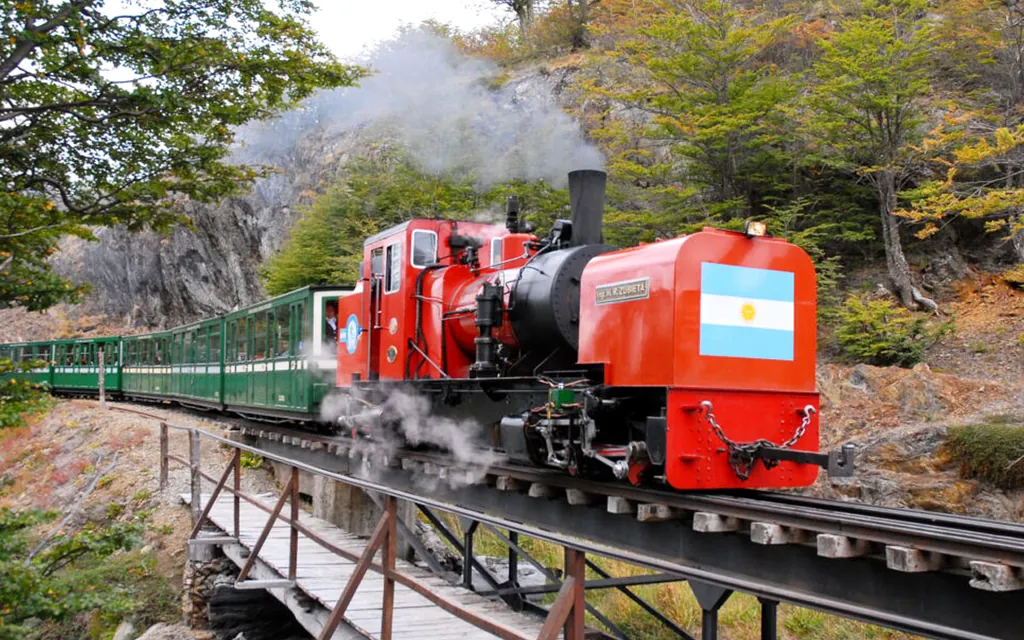
The classic half day: the prison railway of 1909 and the park where Route 3 finally runs out of road.
More information →
Two or three hours that pair well with a morning sailing: the chairlift and the view back over the channel.
More information →